
Building A Rollercoaster On Stage
How would you recreate a roller coaster in a little theatre? Set Designer Brockman faced that challenge for the Hayes Theatre production of the musical Ride the Cyclone. David Spicer reports.
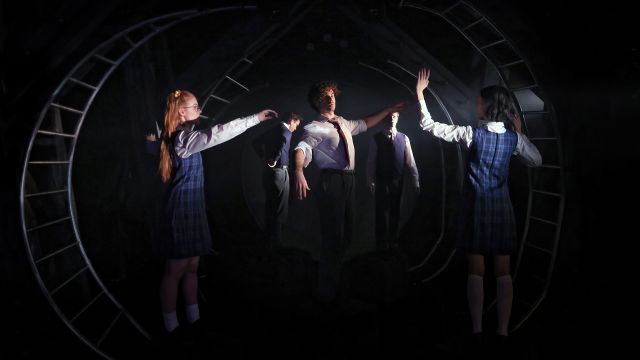
The set design was described by our reviewer Carol Wimmer as “disembodied pieces of rollercoaster rail coiling in a deepening curved void reaching back to a circular screen.” Suzy Wrong said, “it evoked the esoteric, in a way that feels transportive, and fabulously theatrical.”
David Spicer: What is the musical Ride the Cyclone about?
Brockman: Ride the Cyclone is a darkly comedic and deeply thought-provoking musical that follows six teenagers who tragically die in a roller coaster accident. As their spirits linger in a limbo-like state, they are each given a chance to tell their story, hoping to be chosen for a second shot at life.

DS: What was your brief?
B: When meeting with director Richard Carroll, we discussed the core feeling we wanted to evoke in the audience. From the moment they entered the Hayes Theatre, we wanted them to feel like they were stepping onto a roller coaster — transported into a completely different world, unlike anything they’d seen before.
The musical features several moments where the lyrics emphasize the repetitive motion of going "round and round". I wanted to capture that sensation in the design — not just through the visuals but in how the space itself felt. The idea was to immerse the audience in the dizzying, stomach-churning feeling of a roller coaster, even evoking a sense of unease, as if they were on a ride themselves.
Considering we were working with school children characters, the design also had to function as a kind of playground — a space for them to climb, hide, and interact with the environment. This was crucial in creating a dynamic and engaging space for the cast.
While the script provides a detailed description of an abandoned warehouse, cluttered with old theme park rides, we put the roller coaster at the centre of the design. This decision helped ground the show in the thrill of the ride, rather than just focusing on the remnants of a past disaster.

DS: How challenging was it to make a little theatre take on the appearance of a roller coaster? What tricks did you use?
B: It was a thrilling puzzle from the outset. I'd spent a lot of time studying images of roller coasters — particularly the twisted metal and complex bends that stood out as sculptural forms.
One image, taken in an abandoned theme park in Japan, captured the feeling of looking down the centre of a looping roller coaster, creating this dramatic sensation of the ride coming straight toward me. That image founded my initial sketches, which evolved into the design for the show.
We had to strike a balance between providing enough open space for dynamic dance and traditional theatre-making and constructing a world that felt like it had emerged from a crumbling theme park.
Incorporating elements like festoons, LED tape, and hidden electrics brought this idea to life. The pylons that supported the roller coaster tracks were emphasized with lighting, giving them a glowing, carnival-like energy that pulsed throughout the space.
High-gloss black mirrored surfaces and reflective materials made the space appear larger than it was. This layered approach gave the space a sense of infinite depth, much like a roller coaster itself — a journey that twists and turns, leading the audience into unexpected places.
The design had to be bold and unapologetic, extending out over the audience to pull them in even further. The result was one of the most exciting, evocative spaces I’ve ever designed — a roller coaster that wasn’t just a physical structure but a sensory experience. The challenge wasn’t just in making a small theatre feel vast, but in making the audience feel like they were part of the ride itself, swept up in the energy and spectacle.

DS: What was the set built from?
B: The set was built using a mix of wood and steel to create the roller coaster structure. Wooden trusses were used to anchor the set to both the roof and floor for stability.
Custom steel components were carefully bent and welded into a double curve to form the roller coaster track. The track twisted and narrowed as it moved upstage, with staggered pylons creating the illusion of a broken but connected structure.
All steel pieces were welded together and securely attached to the roof and floor trusses to ensure they could support the performers' movements, including climbing and jumping.
Once the structural framework was in place, the set was painted and distressed to give it an aged, abandoned carnival feel. The floor was finished with high-gloss vinyl to create a smooth, reflective surface that worked well with the lighting and projections.
For the rear projection surface, we used grey Sharkstooth Gauze framed by a circular opening, tying the design into the glowing orb held by Karnak, the carnival robot.
Karnak itself was sculpted from polystyrene, coated and finished with a thick paint product to match the weathered look of the set.
The build was complex, but once we navigated through the planning, everything came together.

DS: How sad are you when a brilliant set is torn down after the show is finished?
B: The most remarkable thing about theatre, for me, is its transient nature. A show, a space—everything exists for a moment, and then it evolves, transforms, and becomes something else. The beauty lies in that constant change; the way each production leaves its mark on a space before shifting into something new.
The Hayes Theatre has been reimagined time and time again by brilliant designers, each adding their own layer to the history of this incredible space.
Theatre is an experience—a moment in time when we come together to witness something that speaks to us, whether for escapism, entertainment, political discourse, or to have a hard conversation. And when it's all said and done, the space and the show become part of the past, waiting to transform again into something fresh, new, and inspiring. That is the magic of it—this beautiful, ever-changing journey we all get to be a part of.
Photographer: Prudence Upton