

Australian Open
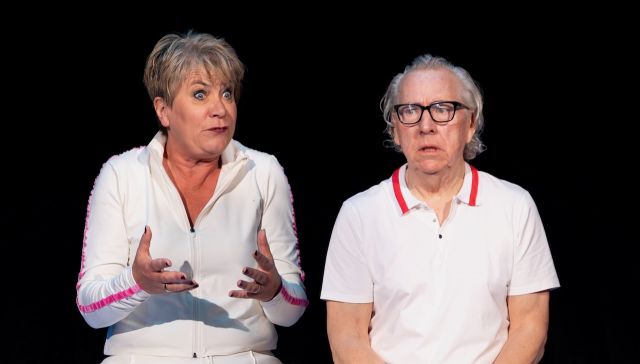
Australian Open doesn’t happen on a tennis court and really it isn’t about on the court tennis at all.
To slightly alter an old dictum, ‘It’s not about tennis, it’s about what tennis means to the characters. Harry Gill’s excellent all-purpose blue and white set is suggestively marked up to look like a tennis court, but all the games on this set are strictly human-to-human and points are scored via put-downs, realisations and declarations. The title Australian Open suggests possibility and opportunity as well as tennis and that’s what Angus Cameron’s light touch, but insightful, funny and beautifully structured text tells us.
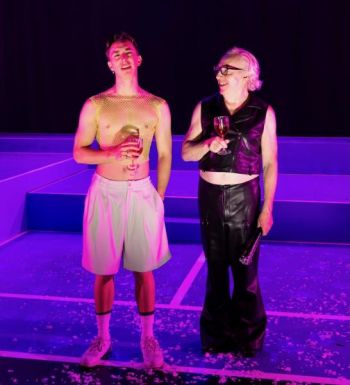
Tennis is what top professional Lucas (Eddie Orton) does. It’s his job. What’s at stake, apart from simply being Number 1(here, beating Federer), is the prestige, the admiration, the sponsorships, and the fringe benefits like continuous sexual opportunities. But Lucas, cocksure, conceited but protective of his reputation, is in an ambivalent relationship with Felix (Sebastian Li) who’s ambivalent about Lucas - and, besides, Felix has little interest in or patience for tennis per se. Meanwhile, Felix’s kindly, benign but also ambivalent trying-to-be-modern parents, Belinda (Jane Mongomery Giffiths) and Peter (Alec Gilbert), look on.
Australian Open is, in its way, an unusual production for Theatre Works but they seem to know they have a hit on their hands; on opening night, the bleacher seating was packed out by chairs in both aisles. But it is, if you like, ‘dialogue heavy; the first scene has four characters at a table, talking and talking in a most amusing bantering way, and drinking a lot of white wine – but it holds. We’re engaged, we’re intrigued – mainly by Felix’ dilemma – and the show is up and running.
There are no special FX, no spirited choreography; the pointed lighting (Sidney Younger) and music (Jack Burmeister) are completely at the service of the play. Burmeister is aware that Australian Open makes different demands on his skills, but he rises to the challenge so well that his sound design and music might even reach that high standard where most of the audience might say, ‘What music?’
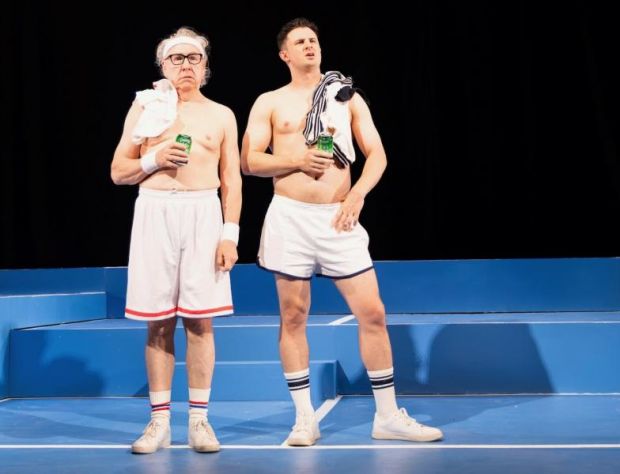
Meanwhile, Director Riley Spadaro (without whom this play might have disappeared) gets the rhythms just right – from breakneck repartee – worthy of the old screwball comedies - to moments of pain and self-realisation. Fast moving transitions are not just smooth, they are often funny in themselves – particularly when embarrassment is involved. Spadaro gives all the characters their due – even Lucas.
As the play proceeds, we see the characters begin to change in wholly credible ways under the pressure of the new uncertainties in the current situation. After years – and years – of marriage, Belinda develops a taste for risk and adventure (which brings about some of the play’s funniest moments). Peter begins to question his sexuality and – with Lucas as a guide - explores the gay scene. Alec Gilbert elicits enormous sympathy and laughter for his confused but strangely happy Peter.
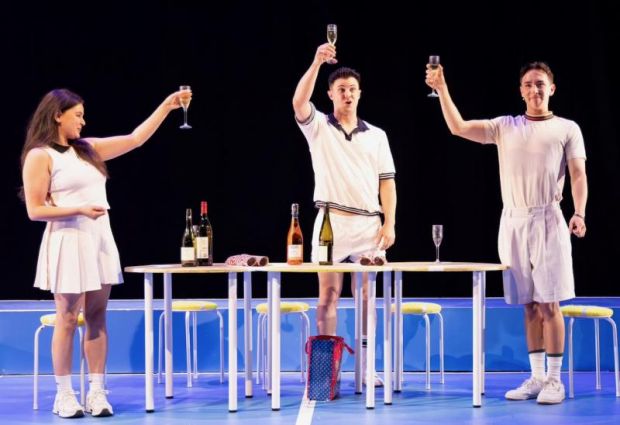
Just when we might think the characters’ developments have stalled and the play is marking time, Angus Cameron introduces a wild card: Felix’s free-spirited sister Annabelle (Melissa Kahraman) who’s been working in Switzerland on the Large Hadron Collider. Cameron doesn’t lean on the metaphor, but it’s there. Annabelle’s matter-of-fact and uninhibited wisecracks – and a certain plot device for which she is inadvertently responsible – are the perfect catalyst for pushing the others to confront the truth. In the hands of Melissa Jahraman this is delightfully enjoyable: she is a delight to watch; she’s bursting with life and has the most perfect comic timing that I’ve seen in quite a while.
Yes, it’s a rom-com and for fans of rom-coms, it obeys the rules, but without forcing the issues. It doesn’t reconcile the irreconcilable but in the spirit of the best of the genre, it ends with the required joyous defeat – and an awesome act of courage – and the audience cheers and applauds. Australian Open may not break new ground, but it is a pleasure to watch something so accomplished and so well realised.
Michael Brindley
Photographer: Sarah Clarke
Subscribe to our E-Newsletter, buy our latest print edition or find a Performing Arts book at Book Nook.