

Beyond the Neck

Tom Holloway describes his play as a ‘quartet on loss and violence…closer to a musical quartet than a “straight play”’. And so it is. His affinity for music gives substance to that description, and seeing the play performed, I would be hard pressed to imagine this story being told any other way.
It isn’t a play about the Port Arthur massacre that took place 28 April 1996 when Martin Bryant shot and killed thirty-five random, innocent people and wounded twenty others. It’s about what that massacre meant and comes to mean to four specific characters ten years later. It is a play about grief and ways of dealing with grief – helplessness, depression, denial, suppression, evasion, conspiracy theories - and guilt. It is about the shock and fear that comes from an apparently arbitrary outburst of deadly violence out of a clear blue sky. We have seen – and felt – that recently.
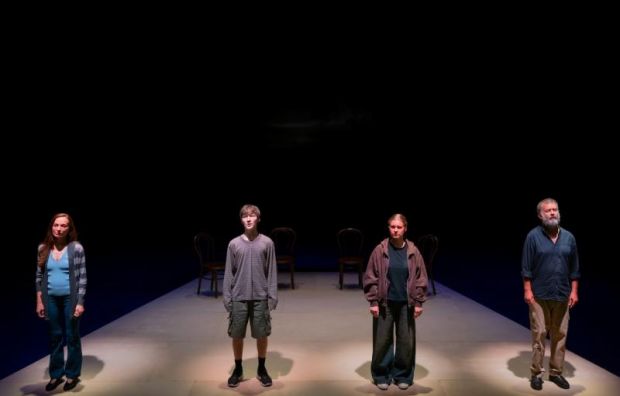
The four very individual storytellers – a Young Mother and wife (Emmaline Carroll Southwell), a Teenage Girl (Cassidy Dunn), a seven-year-old Boy (Freddy Collyer) and an Old Man (Francis Greenslade) – are the voices that tell stories, weaving and interweaving, moving seamlessly and intricately between each other, their pasts and their present.
Playwright Holloway, the cast and director Suzanne Chaundy realise and individuate these characters sharply – in dialogue and monologue, in posture, and attitude. Cassidy Dunn makes us feel her teenage character’s irrational anger and sulking but makes us understand and care for the confused, grieving character underneath. Freddy Collyer transforms astonishingly into the spiky, gangly, motor mouth kid, bursting with energy – and stopped in his tracks by things he can barely understand – yet. Carroll Southwell makes her Young Mother an irritable, ageist, somewhat querulous and in-denial woman – a fragile front for her vulnerability and something close to nihilism. Greenslade’s seventy-five-year-old Tour Guide brings warmth and humour to his old bloke hiding his smoking (which is killing him) from his wife and unable to leave Port Arthur. We’ll come to understand why.

Each of these characters at times also steps out of character to become a sort of Chorus – commenting, narrating, explaining, correcting but also, at times, even interrupting with a peremptory ‘No!’ or ‘Stop!’.
Three of the four were not there at the massacre but now happen to be visiting the site – Young Mother on a mystery bus tour, the Teen jammed in the back of Mum’s new lover’s car on as a ‘family outing’, the Boy who’d rather be playing cricket – with his imaginary friend. Each of them with the baggage of their own lives and which Port Arthur brings to top of mind, threatening to overwhelm them. The fourth, the Old Man, was there but watched helplessly from hiding. BANG. BANG, BANG. BANG…

Emma Ashton’s trapezoid white set is unadorned but for four Bentwood chairs – dominated by Rodney Pople’s 2012 painting Port Arthur, its forbidding subject – the cruellest prison – on its hill, softened by mist. Does Martin Bryant’s ghost hover in the foreground? Ashton’s costumes inform us of the ordinariness of these characters, while Richard Vabre’s lighting emphasises that they are not ordinary at all.
Of particular note is Philip McLeod’s original plangent cello score, composed for the 2012 production. I cannot think of better or more moving music for a theatrical production, complementing the emotions of the characters perfectly. Here, McLeod’s music has been incorporated into Jack Burmeister’s always skilful sound design, enhancing its power and adapting it to sync with the onstage action of this production.

Beyond the Neck exhibits the immense skills and emotional depth of writer, director and ‘creatives’. Suzanne Chaundy’s direction shows exquisite judgement not just of performance but in her use of this bare set and four chairs. But Holloway’s text too is a matter of exquisite judgement not just in his creation of vivid characters but also in that weaving and interweaving of the voices that give the work its musical quality.
Perhaps there is no resolution, but could there be? Holloway’s non-judgemental sympathy can’t countenance any forced reconciliations. The past and the pain remain. The only comfort is our ability to comfort one another.
This is a fine, indeed flawless, production.
Michael Brindley
Photographer: Steven Mitchell Wright
Subscribe to our E-Newsletter, buy our latest print edition or find a Performing Arts book at Book Nook.