

Control
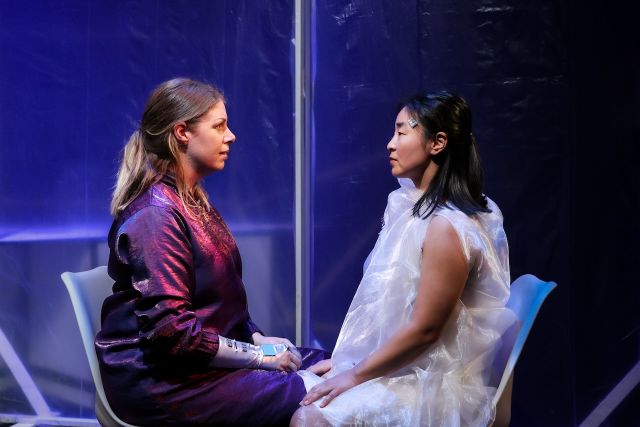
Control is a sci-fi play about three visions of the future, via three variations of ‘control’: being controlled, attempting to regain control, and losing control. In its way, it is reminiscent of Charlie Brooker and Annabel Jones’ Black Mirror television series in which the characters adopt and use technology, only to find that they are trapped and the outcomes are not at all what was expected.
In Act I, four hapless travellers are about to land on Mars! There’s heavily pregnant Elizabeth (Faran Martin), handsome, supposedly in command Jake (Lachlan Herring); Laura (Seon Williams) is the spicy, wisecracking Playgirl. And recessive Andrew (Alex Duncan), bizarrely a puppeteer for children...
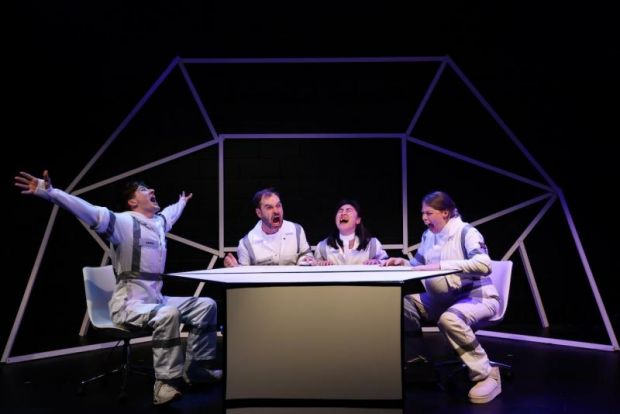
Now, with the commercialisation of space travel, this is not completely unlikely, but playwright Keziah Warner takes it a step further – and director Olivia Staaf does a fine job showing the characters at the mercy of the spaceship’s technology – which none of them understand, let alone control – and how they are obliged to take part in a ‘reality’ television show, supposedly about themselves and their feelings on the brink of the amazing arrival. What the show’s unseen producer-controllers back on Earth demand is nothing but clichés and banality – which will reassure the viewers, 60 million kilometres away, that all is well – and ‘normal’. Except that it’s not...
In Act II – a projection tells us it’s TWENTY YEARS LAER – we’re in the Museum of Childhood Memories (slogan ‘We Look After Your Memories So You Don’t Have To’) where two clerks – Martin and Williams - who supposedly control memories but can do so only within the rules set by some all-powerful corporation. Apart from refusing requests to excise damning memories, they work out how to ‘control’ a partially programmed grumpy and uncoordinated cyborg. They ask it questions it can’t answer and make it do ridiculous dance moves until it falls over. Underlying their childish glee is the suggestion that, in this future, about the only ‘control’ they can achieve is this. It’s possible that this Act II isn’t strictly necessary, but it is redeemed by Duncan’s terrific and very funny performance as the cyborg.
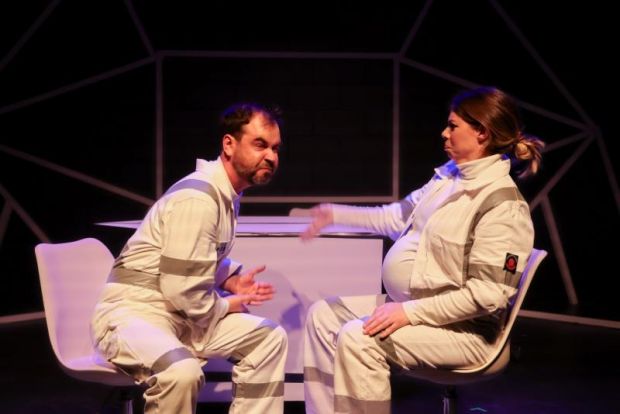
Act III is set ‘THIRTY YEARS LATER’ and sees an increasingly uncertain and flustered human, Isabelle (Martin), attempt to program a very advanced cyborg Esta (Williams) to become a children’s teacher. This is the most successful of the three Acts: it’s less of a sketch, the overt comedy is restrained, it is psychologically acute and performed with meticulous detail. Both Martin and Williams are brilliant here. Williams’ attention to detail with her robot is astonishing while Martin suggests layers of emotion well outside and brought to the surface in this encounter. The programmer, Isabelle, becomes a rounded character: we begin to wonder about her life when she is off duty.
But unfortunately, even this more substantial Act III does repeat itself and runs longer than it should. We get the point, it’s intriguing, it’s moving, it works – up to a point – but the audience gets restless, anticipating ‘the end’ - or at least a more definite pay-off.
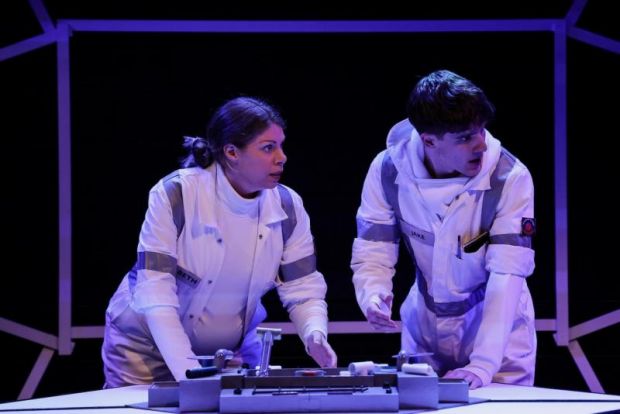
Director Olivia Staaf achieves and maintains three very different styles and tone in the cast’s performances – brisk and utterly clear – but the problem with Control overall – timely as it is - is that it doesn’t go anywhere and leaves us with nothing much to take away. What it presents are three situations – the first two more sketch comedy than comedy. Although there is no doubting Keziah Warner’s ability with dialogue and her invention of comic, pointed scenarios, what’s missing is some answer to the questions, ‘And?’ Or ‘So?’
Michael Brindley
P.S. Control was originally commissioned and developed by the Red Stitch INK program and produced by Red Stitch in 2019 - albeit with a different – but equally fine - cast, director, et al. Although since then we have had the expansion (onslaught?) of AI, the play’s visions of the future haven’t changed that much.
Photographer: Kate Cameron
Subscribe to our E-Newsletter, buy our latest print edition or find a Performing Arts book at Book Nook.