

Deal With It
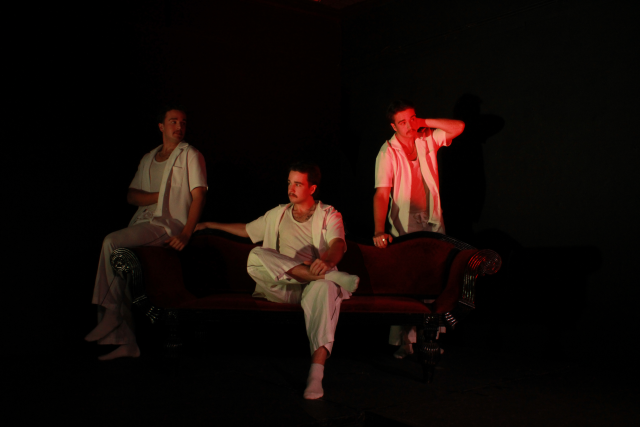
Staged in the intimate upstairs space at PIP Theatre, Deal With It wastes no time establishing its tone. Co-written and directed by Aimee Sheather and Aarya Dath and produced by HansonCreative, the show leans hard into dark comedy to poke at misogyny, entitlement, and the quiet violence that sits beneath everyday interactions. It is slick, sinister, and knowingly playful, often funny enough to lower your guard before reminding you exactly what it is really about.
 Deal With It is unsettling in a way that slowly creeps up on you. It starts playful and familiar, almost cosy, then tightens scene by scene until the humour feels sharper and the stakes feel heavier. The mix of dark comedy, horror elements, and everyday share house dynamics keeps you off balance, never quite sure whether to laugh or brace yourself. By the end, the room feels thicker, charged with a sense that things have gone too far too fast.
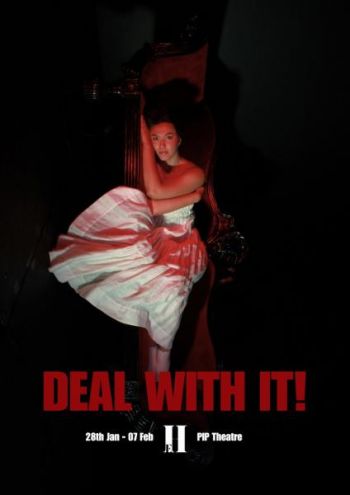
The show revolves around Bridget (played by Gianni-Mia Attril-Dowling - pictured right), a quiet and mysterious young woman who has made a deal with the Devil. Attril-Dowling plays her as distant and composed, but never fully stable. She moves between detachment and intensity with ease, creating a character who is difficult to read and therefore impossible to dismiss. However, there was a moment where a prop fumble during a high-stakes confrontation briefly undercuts the emotional momentum and proves difficult to recover from. Attril-Dowling recovered the moment with humour, but her serious tone did not return as fast. Even so, her performance remains a strong anchor for the play’s moral unease. When the show finally hits the heavily foreshadowed crescendo, Attril-Dowling’s performance throughout helps you feel like you truly understand the way Bridget’s mind has been twisted and almost sympathise with her tragedy.
 Pulling Bridget’s strings throughout the show, Caleb Hockings plays the devilish Zizi (aka, Beelzebub). The actor was clearly having a great time playing as the Devil, and that enjoyment largely works in the character’s favour. His scheming physicality is precise and playful, constantly fixing, adjusting, and interfering with the set and the story. A blink and you’ll miss it moment occurs at the climax when Hockings silently mouths another character’s dialogue, a subtle and chilling reminder of who truly holds the power. Zizi’s costume is a standout – a sharp black suit adorned with red sequins and rhinestones forming a dripping wound across his body, paired with a classic pencil moustache makes him instantly striking. Occasionally, Hockings’ deep and dark vocal choices veered into vaudevillian rather than villainous, but the confidence in which he delivered his lines more than made up for this and seemed to add to the air of dramatics befitting a Devil.
William Kasper delivers excellent comedic work as Alix, leaning fully into the oblivious boyfriend archetype. His timing and facial expressions generate easy laughs, but there is something darker underneath the humour. His fixation on trivial interests and refusal to notice warning signs becomes an unsettling portrait of passive complicity.
Opposite Kasper, Ruby Gleeson’s Max is particularly interesting in her trajectory. Initially she reads as quirky and grounded, but her turn toward investigation quickly becomes unhinged. Touching murder weapons and plunging her hand into a pool of blood feels like an insane choice for an otherwise observant character, a choice that literally left her red-handed. However, a revelation later in the play that she is secretly involved in shady dealing reframes her earlier behaviour and confirms that she was never as innocent as she appeared. Cooky rather than quirky, in hindsight. This moral slippage is one of the play’s more effective turns as it reflects how innocence can be a performance too.
 Kasper’s chemistry with Gleeson’s Max is light and believable at first, playful and unserious. During a clever transition that shows time passing and the characters becoming more comfortable with each other, Kasper and Gleeson show that chemistry erode. Max subtly stops reciprocating Alix’s bids for connection, a shift that feels carefully directed and emotionally honest, making the slight erosion of that connection feel earned and sad and the resulting crescendo feel inevitable.
Supporting performances from Kyle Armstrong as John the delivery man and Connor Costin’s medley of men helps to ground the play. Armstrong’s John arrives as a sarcastic outsider. He quickly becomes Bridget’s love interest, and his seemingly genuine persona helps him win over the audience just as fast. Meanwhile Costin’s transformations across roles were fluid and believable. Although each of the men were quite similar to each other, Costin’s performances varied just enough to give each role their own voice.
The writing by Aimee Sheather and Aarya Dath is clever and quick, with a strong sense of humour that often reflects real world situations in an honest yet twisted way. The dialogue feels intentionally heightened, but never random. People talk around the truth, dodge responsibility, and joke their way out of accountability, which makes the darker turns land harder. The script is especially effective when it allows characters to be messy and contradictory rather than neatly “good” or “bad”. Toward the end, the writing moves very fast, stacking big moments on top of each other before the audience has time to fully process them. That rush slightly blunts the impact of what should be the most confronting beats. Still, the writing is confident in its politics and unafraid to provoke. The humour is sharp and never gentle, making your laughter feel almost like a trap.
Production design by Aimee Sheather is confident and highly stylised. A minimal set dominated by red and black does a lot of heavy lifting. A luxurious red couch with black accents sits at the centre of the space atop a plush red carpet. It feels seductive and dangerous at the same time. This visual language is echoed throughout the show, reinforcing the idea that comfort and threat are never far apart. Complimented by the sound design by Aarya Dath, this sinister notion is a constant presence that slips through scenes and quietly pulls the strings, making the entire world feel manipulated. Nothing ever feels incidental.
Deal With It leaves a lasting impression. It is ambitious, politically charged, and unafraid to be abrasive. It understands how easily harm can be rationalised, excused, or dressed up as something else entirely. By the end, the Devil, or Zizi, does not feel like an external force at all, but a reflection of systems already at work. The horror is not just in the deal that was made, but in how familiar it all feels. The play understands that horror does not always arrive with a scream. Sometimes, it sits comfortably on a red couch. Smiling. Waiting for you to agree.
Review by Rebecca Lynne
Tickets: https://piptheatre.org/deal-with-it-2026/
Dates: 28rd of January to 7th of February 2026
Venue: Pip Theatre, Milton
HansonCreative: https://www.hansoncreative.org/
Photo credits: Emma Hanson
Subscribe to our E-Newsletter, buy our latest print edition or find a Performing Arts book at Book Nook.