

Fair Play
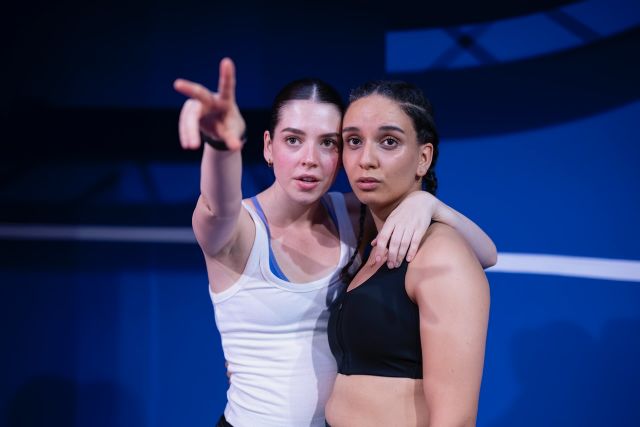
British playwright Ella Road wrote Fair Play based on her own experiences as a competitive runner. But it could be about any sport where girls are pushed, or push themselves, beyond safe health limits … gymnastics, athletics, swimming, football, ballet, tennis …
Journalists report stories of harsh coaches, pushy parents, impossible training routines, eating disorders, bursaries, sponsorships, mental issues, drug testing …
Road touches on all of these and more in Fair Play – and in doing so requires an enormous commitment from the actors who play two young athletes from different social and cultural backgrounds striving for national and international goals.
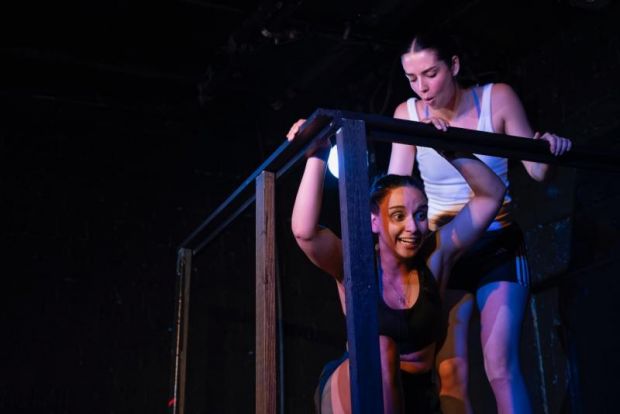
Elodie Westhoff is Sophie who has been training for some time. She comes from a background of privilege. Her mother picks her up from training. She refers to the coach by his first name!
Rachel Crossan is Ann who comes to training as a teenager. Ann is an English-Nigerian student who copes with the pressure of study and religion and culture as well as her athletic ability. She is fast – and has been ‘earmarked” for success.
They meet at training and, and, after a shaky beginning, they connect more personally.
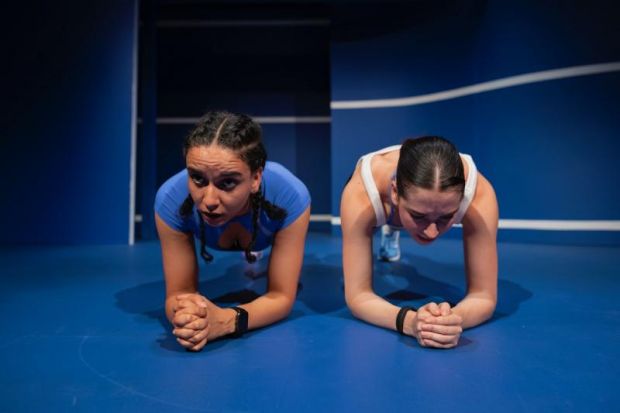
Pushed by “Coach’, they aim high, hopeful not just for a medal – but for a sponsorship that will give them monetary support. Their training routine is harsh but they are determined, despite family issues that arise.
And they eventually make it to a European 800 metre final …
For 100 minutes the actors are virtually “in training” on a bare stage framed by a high, curved blue track to which designer Kate Beere adds a white lane line that pulls into recesses behind the stage. The set implies distance and, cleverly, a sense of oppression that works perfectly on the compact Old Fitz stage.
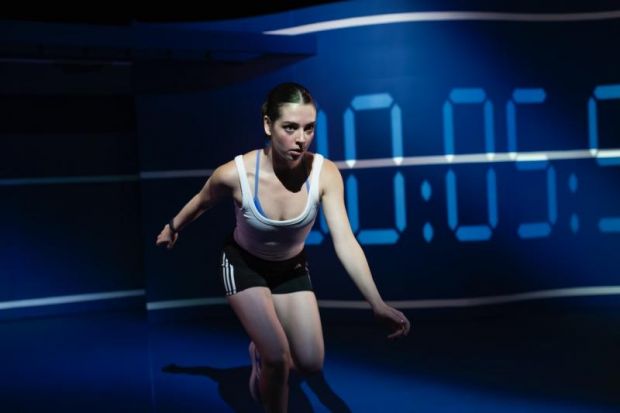
Choreographer Cassidy McDermott Smith sets the actors a gruelling training routine. Each section of dialogue is preceded by different strenuous exercise routines, stretches and cross stage sprints. And yet there is never an instance where either of the actors sounds breathy or hesitant as they stop and break into dialogue.
Director Emma Whitehead obviously nurtured her cast physically as well as emotionally as she guided them through this very challenging production. The blocking/choreography must have been as hard to remember as the dialogue and the changes in rhythm especially as each section of dialogue explore a different stage in the girls’ relationship – and their training.
The physicality and fitness required for this production is as important as the development of the characters, their relationship, the different tensions that arise … and how they deal with “the odds stacked against them”.
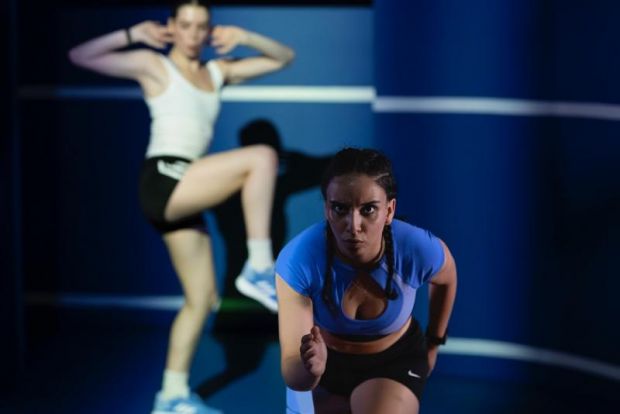
This isn’t just a play about two young female athletes. It’s about how difficult it is for women to ‘make it’ in sport; about expectations; about limitations; about impossible guidelines; about giving in … and finding ways to fight back.
It is an amazing piece of theatre performed by two very fit young actors supported by a very aware, sensitive and sentient creative team.
The run isn’t long. The capacity of the theatre is small. But it’s a “must see’ for any young sportswomen … or actors …. or ‘hover’ parents …
Carol Wimmer
Photographer: Robert Minter
Subscribe to our E-Newsletter, buy our latest print edition or find a Performing Arts book at Book Nook.