

A Few Good Men

Using a minimalist set, clever lighting by Michael Arnott, and impeccable staging, this dramatic courtroom thriller has been brought to life in a gripping production directed by Paul Winchester and Blair Cutting. A Few Good Men tells the story of a Marine’s death at Guantanamo Bay and the subsequent trial, unfolding at a cracking pace while wrapping the audience in a blanket of nostalgia and memory. This version is a delight, proving that theatre can make old stories feel fresh and urgent.
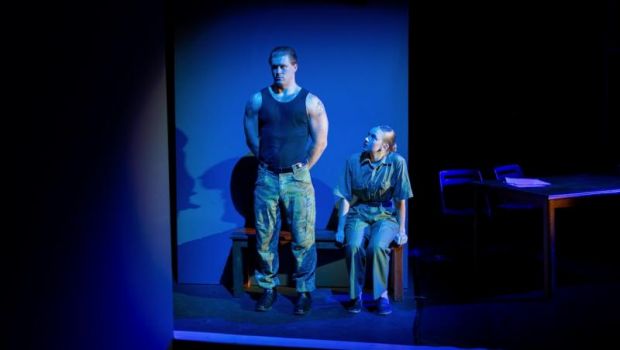
The play skilfully jumps between current events and flashbacks of Private William Santiago’s death, played with poignancy by Andy Hastie, and the chain of events that followed. These shifts are seamlessly managed through clever staging and lighting, allowing actors to move fluidly between scenes, often leaping between times and locations with ease and a deceptively seamless melding of worlds.
Lieutenant J.G. Daniel Kaffee, played by Bailey Parker, commands the stage and the courtroom with a delicate mix of humour, strength and bravado. Parker stands tall in the big shoes this role demands, continuously driving the action with an energy and charisma that make his performance both compelling and witty. His portrayal captures Kaffee’s quick wit, growing seriousness, and moral awakening, making him the beating heart of the production.

He is ably supported by Lieutenant Commander Joanne Galloway, played by Julia Grace, and Lieutenant J.G. Sam Weinberg, played by Michael Haratzis. Grace brings quiet determination and principled strength to her portrayal of Galloway, challenging Kaffee to take the trial seriously and imbuing the character with a steadfast desire for truth and honour. Haratzis provides a measured, thoughtful presence, balancing the intensity of the courtroom with humour and perfectly timed gestures, proving that silence can speak as loudly as words. Together, they form a defence team that is dynamic, believable, and emotionally resonant.
Liam Dewar portrays Lance Corporal W. Harold Dawson with loyalty and conviction, showing the inner conflict of a Marine whose rigid belief in the chain of command shapes his every action. Jacob Gardner’s PFC Louden Downey contrasts beautifully as the younger, more vulnerable Marine, combining physical strength with the vulnerability of a man lost in the moral fog of obedience.
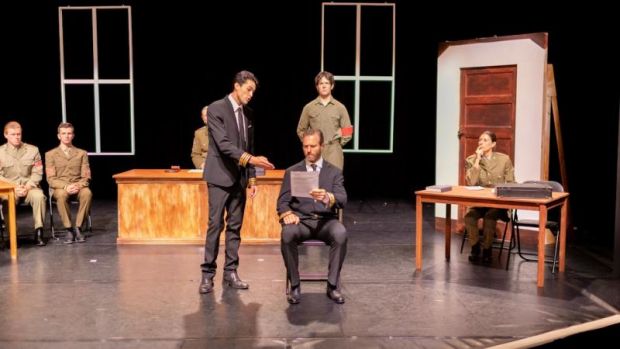
Other key characters are portrayed with equal skill. Ale Feudal’s Captain Jack Ross is polished and commanding, perfectly embodying confidence and intelligence. Alexander Wright’s Jonathan James Kendrick radiates gravitas and authority, creating a senior Marine whose moral complexity is both intimidating and central to the courtroom drama. Lee Sarich’s Matthew A. Markinson switches effortlessly between duty-bound soldier and man wrestling with conscience, delivering a raw, emotionally charged performance. David Allsop’s Lieutenant Colonel Nathan Jessep steals the spotlight with forceful dogmatic self-assurance, delivering one of the play’s most famous lines with terrifying conviction.
Supporting these leads is a stellar ensemble—Bron Calcraft, Will Rodriguez, Josh Stanes, Callum Horan, Jared Coughlin, and Andy Hastie—who bring humour to the darkness, strength to the truth, and a palpable sense of the human cost of blind duty and obedience.
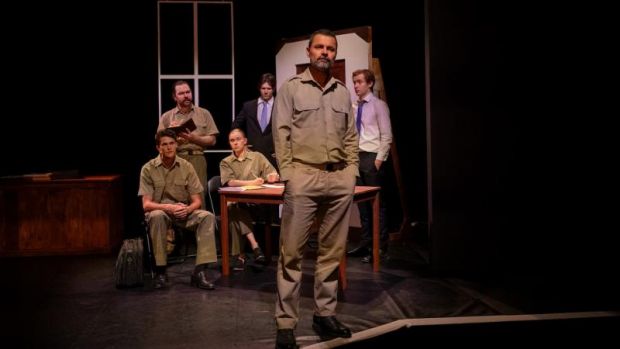
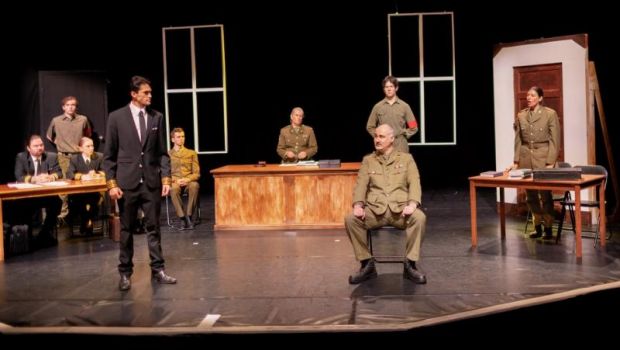
Michael Haratzis’ set design is minimalistic yet functional, allowing actors to move between three primary locations with clarity and fluidity. The staging complements the rapid dialogue without impeding the story, while the clever lighting helps mark shifts in time and place, maintaining narrative momentum.
This production honours the well-known story while offering fresh insight into the tension between truth and duty. Fast-paced, intelligent, and occasionally darkly humorous, it’s a must-see for lovers of courtroom drama and character-driven theatre alike. Dynamic, gripping, and thoughtfully staged, this version of A Few Good Men is a theatrical triumph that proves the play’s enduring relevance.
Sarah Webster
Subscribe to our E-Newsletter, buy our latest print edition or find a Performing Arts book at Book Nook.