

Nihilistic Optimism on Trampolines
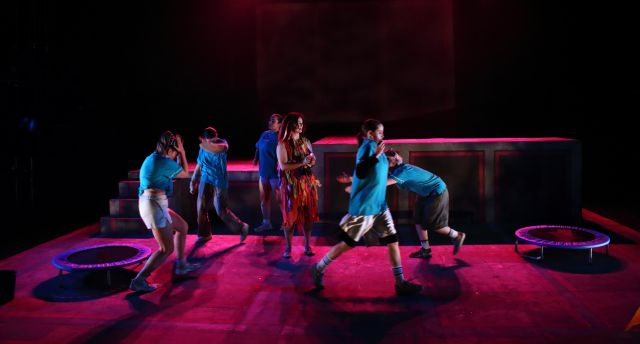
It’s a slow day at the Trampoline World store. An unlikely competition is suggested to wake up the bored, disaffected, fractious and listless staff: everyone is to write a ‘ghost story’. Such is the premise – or set-up – of Kasey Barrett’s ingenious, insightful, but sometimes contrived play.
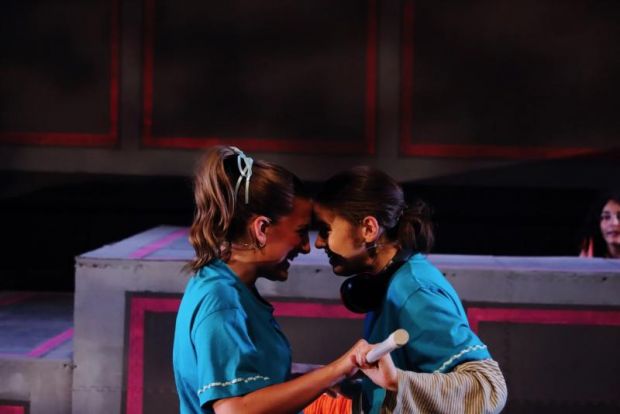
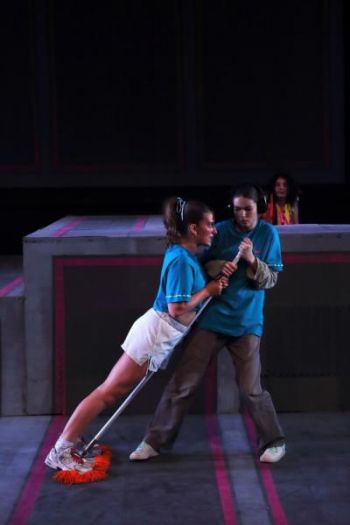 Some staff are not interested in the ghost story idea; for others, it’s quite beyond them. But one, Mary (Gabrielle Ward), seizes on the idea – and for the rest of the play she’s at work: she scribbles in a scrappy notebook, revising, discarding. At times she’s inspired, at others despairing... and quoting – or is it channelling? – Mary Shelley’s novel Frankenstein or from Mary Shelley’s personal journals – even while being harassed – sometimes physically - or just interrupted by other employees jealous Percy (Bek Schilling), Byron (Eleanor Golding), muscular Claire (Sophie Graham Jones) or John (Zoë Wakelin).
We might twig from the names that playwright Barratt is suggesting a parallel world to the Trampoline World store – that of the 1816 storm-battered and driven indoors Geneva conclave of Mary Shelley, Percy Bysshe Shelley, Lord Byron, his lover Claire Clairmont, and his doctor John Polidori. Barratt is fascinated by these historical figures, especially Mary Shelley. The world of 1816, she says, chimes with our present – a chaotic and uncertain world, in which there is an on-going battle between nihilism and optimism. Hence her title.
Most interesting and intriguing of all is where Barratt takes this. She believes that Frankenstein is ‘an exploration of [Mary Shelley’s] fears and anxieties’. Most readers of the famous novel might say that it is about rather more than that, but it’s Barratt’s premise, she puts it on stage and makes it work. The monster – here called the ‘Creature’ (Jett Chudleigh) - emerges as a manifestation not of scientific experiment but of Mary Shelley’s powerful inner emotions. These, not finding an outlet or acceptance, can spiral into despair and violence.
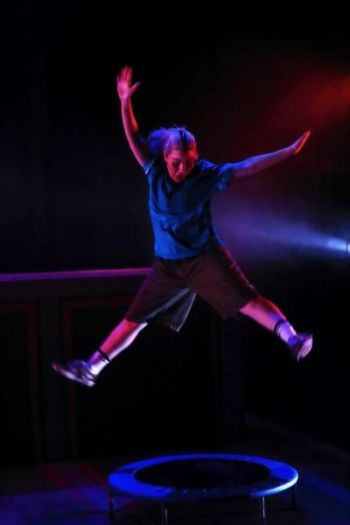 Barratt (also the director) leads us to anticipate a dangerous and destructive Creature, but when Chudleigh’s Creature appears full figure, she (It?) is a sweet-faced attractive figure that charms and wins our hearts in her initially clumsy attempts to stand upright and walk. If she represents Shelley’s inner emotions, they are open, curious and hopeful. But the Creature finds a world that is not so welcoming... The interactions between the Creature and Mary (both in the present and in1816) are the most powerful and touching elements of this story, strengthened by Gabrielle Ward’s lovely reading of Shelley’s own texts with their clear and so articulate difference from the language of the present.
While on one level the characters continue to be naturalistic customer service employees with petty or banal feuds and jealousies, on another level they reflect and represent the rivalries and competitive behaviour of the 1816 historical figures, whom Barratt invites us to see with a ‘new lens’. Most salient is Percy’s near assaults on Mary as she tries to write – interesting in that historical Percy commandeered historical Mary’s manuscript to ‘improve’ her prose...
To one side of the stage is the band – Jackson Cross, guitar; Darby Ferguson, bass; and Nicholas Costa, drums – who provide bursts of rock music and comic sound effects, but they are also, just to weave them into the fabric of things, Trampoline World’s stroppy maintenance crew.
Where Nihilistic Optimists on Trampolines gets in its own way, however, is the arbitrary jamming together of ideas that don’t mesh or illuminate. The store’s boss suggesting a ghost story competition sets up the action, but the contrivance creaks. While the past/present parallels mostly work dramatically – if we know the backstory – the connections are rather stretched and can feel forced. The chorus line dance numbers are fun, but the relevance is elusive.
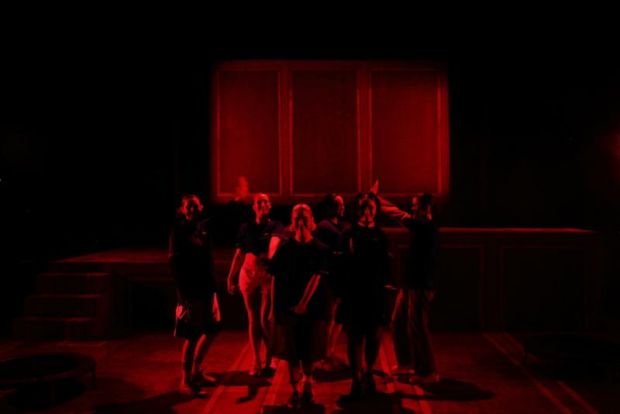
Crucially, why trampolines? Because, says Barratt, ‘what if [her] characters were so bored they started bouncing off the walls.’ A tenuous and distracting connection. In fact, the trampolines are there, but play very little part in the action. ‘Trampoline World’ could be almost any workplace as far as I could see.
The play was developed through Theatre Works ‘Fresh Works’ program and with the production Barratt has some brilliant collaborators – Elyssa Barratt as co-choreographer, Josh McNeil for set and costumes, Sophia Jargovic and John Sharp for sound and competition, and there is Tom Vulcan’s always fine lighting. But she also has had top class dramaturgs, Rosa Ablett-Johnstone and the inimitable Belle Hansen. But I guess that even they could not mess with the arbitrary premise or the trampolines.
Nihilistic Optimists on Trampolines is Barratt’s first full length play, and it is bursting with her talent, ideas, emotion and a willingness to confront complex issues – even if that confrontation doesn’t quite come off all the way through – when the ‘concept’ overtakes dramatic sense. But I look forward to whatever Barratt does next.
Michael Brindley
Photographer: Sian Quinn
Subscribe to our E-Newsletter, buy our latest print edition or find a Performing Arts book at Book Nook.