

Now
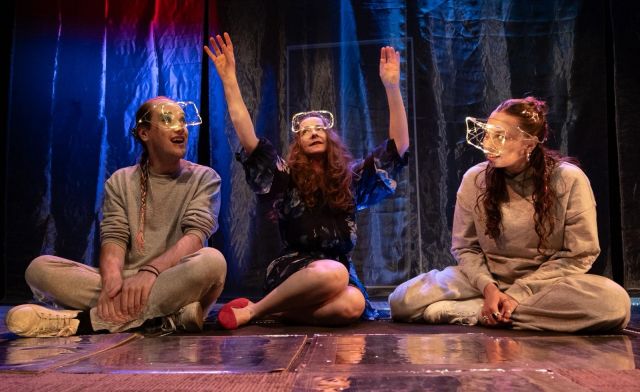
Now is a lyrical work that edges into what might be called Theatre of the Absurd. It is a tale of parallel worlds: the quotidian, everyday world that we think is real, and another world, a world of the mind, called Now where imagination can make dreams come true. At least, this is my understanding of Helene Tardif’s short play.
A young man, a Son (Andrew Drava) is seen by his parents – Father (Marc Opitz), an overworked advertising man, and melancholy Mother (playwright Helene Tardif) – as a lazy layabout.
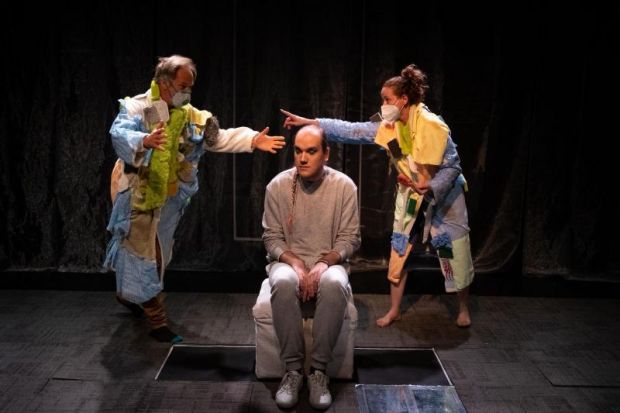
But the Son discovers Now which exists on another (mental) plane – but which can, nevertheless, interact with the ‘real’ world. In short order, Father finds himself fired after twenty-five years with his agency. Perhaps worse, his replacement is his totally unqualified Son! How can this be? It can be because the Son inhabits the world of Now… In that world, the Son is better qualified than the Father.
Virgin Son also finds the ideal girlfriend too – she’s called, appropriately, First (Georgina Scott), sexy and all too willing. Soon, First is pregnant as well. In the real world or what? All this is quite overwhelming for the Mother – unless and until she too can enter Now…
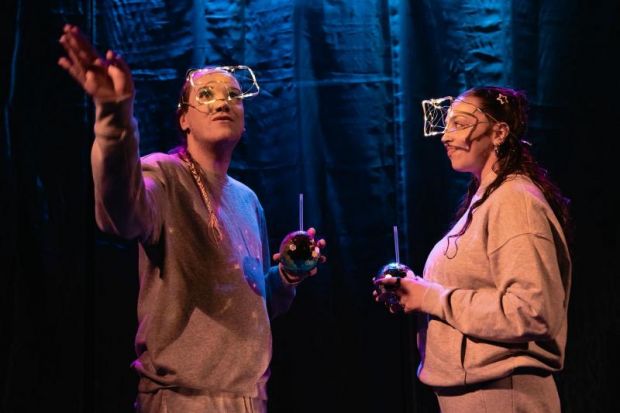
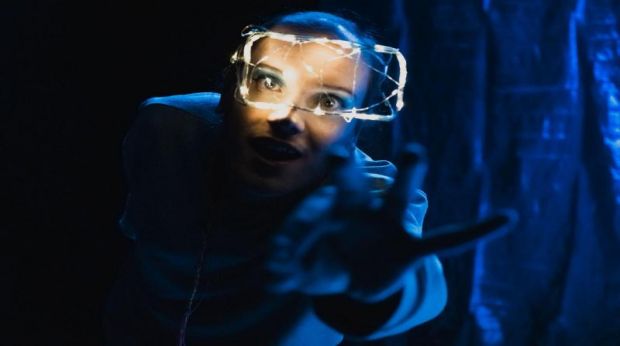
Now can be confusing in its logic and in its storytelling choices. Entry into Now seems to be achieved simply by believing it exists (i.e. it’s there all the time) and is indicated by the characters wearing a head piece rather like Virtual Reality headset, ringed by tiny lights. Then, at various times, characters turn over carpet tiles to reveal mirrored surfaces underneath which they regard with wonder. No explanation is offered for this, but we learned after the show that the mirrors are substitutes for projections that the production could not afford. The Mother undergoes several costume changes whether of her own volition or because of Now it is difficult to say. Eventually, all are freed, and the play seems to tell us that that we must recognise that Now is there for all of us – if we choose.
Director Marion Arditti and Tardif’s text are somewhat let down by the cast. Marc Opitz plays on one note and shouts a lot. Tardif herself has a sweet, winsome quality, but offers not much more here. Andrew Drava’s entry into Now seems mainly to make their character smug and creepy rather than liberated and happy.
Overall, the play is possibly under resourced so that Arditti and designer Silvia Shao have been forced to improvise – such as with the confusing mirrors. We glimpse or perhaps guess at profundity and a European artistic intention, but the presentation lets things down so we don’t seem to quite get there.
Michael Brindley
Subscribe to our E-Newsletter, buy our latest print edition or find a Performing Arts book at Book Nook.