

Peace in Our Time
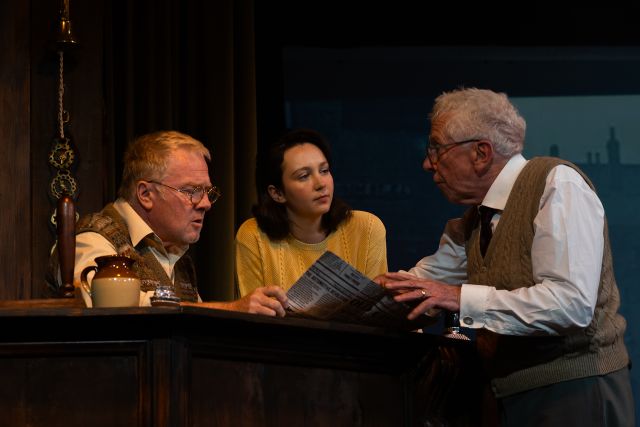
The Shy Gazelle is a bustling pub just off Sloane Square in central London – old-time tavern, so the décor is varnished wood and nicotine-stained wallpaper. The beer is hand-pulled by Fred, a cardigan-wearing landlord, his daughter Doris chats to gentlemen through the serving hatch, and his wife cleans glasses and makes conversation with those sitting at the bar.
But it’s 1940, and in this alternate reality, the Germans have invaded the country after winning the Battle of Britain (an air battle that occurred over several summer months). It’s a tumultuous time with patriotic pride challenged, and each person deciding how best to live within the constraints of an occupying power.
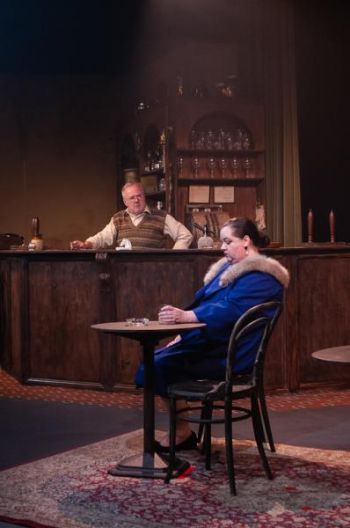 The micro-society of a public house is a brilliant location to explore what that means and how that’s different for each person – how an individual understands ‘peace’ and what they must do to find it in themselves. Director Geoff Brittain has taken Noël Coward’s 1946 play and given it life on the Stirling Community Theatre stage.
The pub’s regulars are introduced to the audience in the busy opening scene: Alma Boughton (played with relish by Annabel Whitford) is impeccable in both dress and dry wit, best friends to author Janet Baird (Linda Lawson) – together, using intellect and irony, they take on the opinions of the bristling Chorley Bannister, a literary editor, played with suitably faux-intellect and arrogance by Brendan Clare. Chorley has decided the best life for him is to appease the Germans; Alma and Janet think quiet subversion is a more authentic approach.
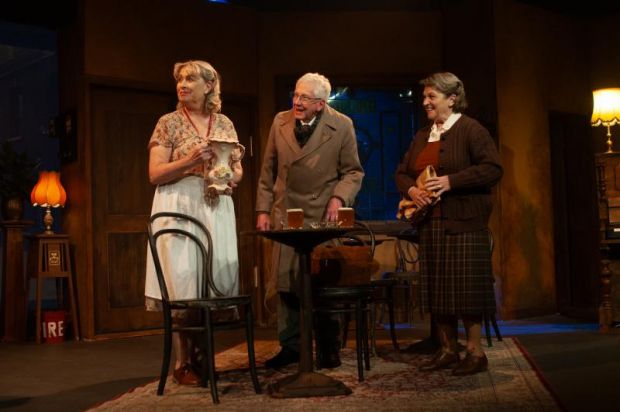
The elderly Mr and Mrs Grainger sip their port, their lives seemingly on hold until they hear news of their prisoner-of-war son. Peter Bleby and Bronwyn Chapple play the couple with understated sadness, the British ‘stiff-upper-lip’ helping them to keep positive in their uncertainty.
Lyia Vivian is a late-night cabaret singer and not afraid to flirt with everyone that can give her an opportunity. Not so much a femme fatale, Tegan Gully-Crispe brings a lighter lilt to Lyia in her performance, which is welcome given the largely sombre ensemble. She happily flirts with Chorley in the presence of her suitor George Bourne (a jolly sarcastic Adam Schultz), clearly enjoying the battle of male ego over her. Gully-Crispe’s smile drops when she’s lit in the cool limelight and she sings songs of the 1940s – her voice period-perfect and grief-filled. Ironically, Lyia reveals her true emotions only when on stage.
Holding them all together are Fred and Nora (Tim Williams and Shelley Hampton), who keep the pub running even when they’re low on spirits – both alcoholic and emotional. Williams and Hampton are utterly convincing as a long-married couple from the moment they appear on stage: those little touches, looks and reassuring smiles cementing the relationship through traumatic times. Their son was lost in the air battle – their surviving family being Doris, who must wonder what she has to do to be loved as much as her lost brother. Tianna Cooper seethes quietly as the daughter, reluctantly obeying her parents’ instructions. Harri Wolff’s Phyllis Mere emerges with a pitch-perfect accent, quietly portraying a young woman escaping the oppression with regular visits to the pictures.
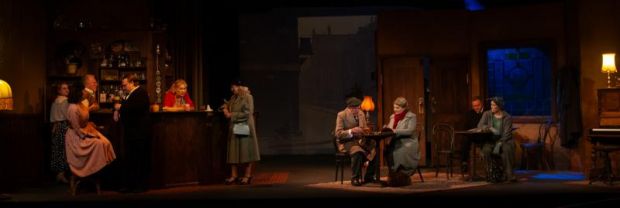
Together, the pub is an expected mixture of young and old, idealist and cynic, fight and defeat: the air-brushed ‘best of British’ from this time, in either the real or alternate timelines. In comes Albrecht Richter, the German ‘liaison’. Sam Wiseman presents the clearly defined bad guy with initial ambivalence, more of a diplomat than an aggressor, seeking to charm the English with his own brand of inclusivity and exploration, wanting to understand the idioms and irony used against him. Wiseman’s Richter is clearly on the wrong side, but he’s also a sympathetic character the audience can’t immediately dislike. In contrast, Clinton Nitschke’s ever-present gun-toting German soldier ensures the audience is reminded of the occupation, and its sympathies are not engaged.
The opening scene is initiated by the amazing set: designed by Leah Klemm, it is a beautiful and realistic recreation of an old English pub from eighty years ago. The hand-pumps move, the horse brasses hang respectfully, the old radio crackles with static, and the stained-glass window has detail that invites closer inspection if we could. Complementing this is the gorgeous lighting from Richard Parkhill: floor lamps and warm-orange glows give an old-fashioned sepia tone to the whole stage and the ensemble. Kristin Stefanoff’s piano is beautiful, played on stage in the pub and in the club for Lyia’s sad songs. The costumes too, from Gil Cordell and Sandy Faithfull, are wonderfully evocative of the era – the play looks and sounds the part.
However, the challenge with such a large ensemble is keeping the story going, and the first act struggles with its pace. The dialogue is dense and the tension only simmers. The second act comes alive a little more, as do the characterisations of those in the pub. There are extra dimensions to almost everyone: Malcom Walton’s stern doctor shows another side; two lost young men are found again: Billy (a well-built character arc from Ky Speedy) and Stevie (a confident Sebastian Hollingsworth). In particular, Doris lifts from sullen daughter to ambitious leader, and Cooper’s development of this is excellent, driving the narrative with more life and action.
Whilst the characters become more interesting, the emotional tension continues to be built so slowly, yet when it is released, it’s ejected so fast that the audience doesn’t have enough time in the moment to process what just happened.
There’s plenty to digest after final curtain, with the differing approaches to ‘peace’ debated through the play sticking in your mind, challenging the audience to consider how they would survive such an invasion. Whilst the wars we fight today are in lands far from ours, the mental invasion persists, and perhaps we need to be meeting in a safe space such as The Shy Gazelle to debate those issues with our families and friends.
Peace in Our Time is a brave but important play to stage in twenty-first century Australia, a memorial to wars fought by our families two or three generations ago and the spirit of those left behind, together with a challenge to how we live through conflict today.
Review by Mark Wickett
Photography by Daniel Salmond.
Subscribe to our E-Newsletter, buy our latest print edition or find a Performing Arts book at Book Nook.