

Perfect Arrangement

American playwright Topher Payne’s Perfect Arrangement is based on the Lavender Scare, the purge of gay employees from government institutions in America during the 1950s. Occurring in conjunction with McCarthy’s anti-communist rampage, it led to thousands of federal employees losing their jobs.
Not a funny theme, but Payne believes “If you can make someone laugh, they listen. And they learn”. And Perfect Arrangement does just that. It is a treatise wrapped initially in the warmth of a comedy.
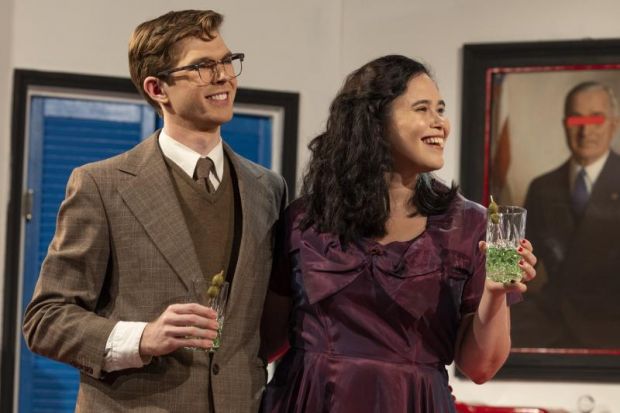
Director Patrick Kennedy cunningly sets the production in a 1950s style TV sound studio complete with camera and applause sign. His direction is symbolic. The set, designed by Patrick Kennedy, is symmetrical, the primary colours unnatural. “The space,” Kennedy explains, “is graphic, symmetrical and deliberately artificial … exposing rather softening … This is not a room to disappear into but one to be examined”.
Sharp lines and angles in stark, symbolic red, white and blue predominate. The direction places the characters firmly in a time when trust was limited, when fear was pervasive.
Kennedy’s direction is exacting, the actors schooled in keeping their characters taut, controlled, conforming – especially as four of them for over four years have been leading a life of deceptions, a “perfect arrangement” that is soon to be threatened.
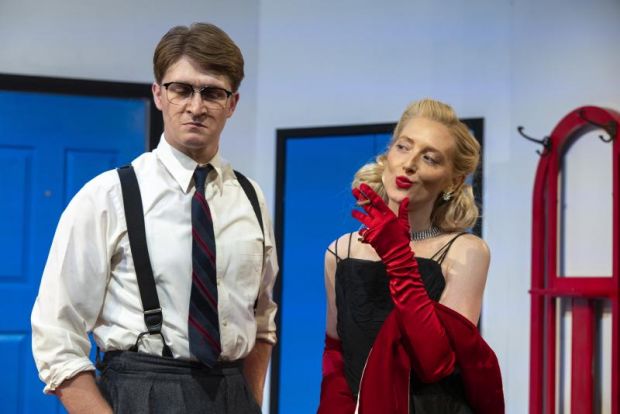
Bob (Luke Visentin) and Millie (Jordan Thompson) and Jim (Brock Cramond) and Norma (Dominique Purdue) are, to the world outside, two happily married couples who are close neighbours. But their world inside is very different! There is a connecting door between their apartments and the happily married couples who live therein are really gay couples Millie and Norma and Bob and Jim!
Bob is a federal employee; Jim is a schoolteacher. Norma is a secretary in Bob’s department. Imagine their dismay when Bob’s boss, Mr Sunderson (Huxley Forras) and his wife Kitty (Brooke Ryan) invite themselves for cocktails and the new purge of sexual ‘deviants’ in government offices is explained. Imagine their further dismay when Bob and Norma find it is their department who will do the “unmasking” and firing.
While they think privately that their secret life will protect them, they cannot predict the way in which their secret will be revealed.

The humour in the first act comes from a send up of the brittle, superficial social life of the middle class of the times. Playing a part, trying to impress, laughing too hard at things that aren’t very funny. These scenes are carefully contrived and managed – until the couples are alone and at ease, and able to consider seriously the implications of Bob’s new role. The people they will have to ‘out’; the possibility of being ‘outed’ themselves.
Things become more serious – and complicated – when Mrs Sunderson takes up stay-at-home Millie as her new best friend, and one of the other government employees Barbara Grant (Lucinda Jurt) recognises Millie from a previous ‘encounter’.
The pace in the second act is faster, more tense, the inter-relationships more strained, the characters more authentic … and their individual decisions more revealing. Kennedy ensures Payne’s messages are clear.
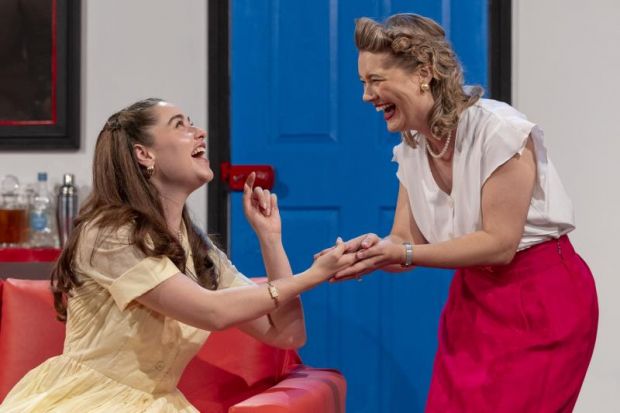
So carefully is this production directed and performed that it would be wrong to single out particular performances. Their concentration, timing, use of space and distance, their clarity and change of pace are indicative of intense rehearsal and strong character development.
Patrick Kennedy brings this play to Sydney at a time when the world is seeing a revival of rights “once again being contested, reframed, or quietly eroded” and where social media allows people to “curate immaculate versions” of their lives.
And as Sydney begins to celebrate Mardi Gras, Kennedy’s production is a telling reminder that “queer history did not begin with pride but with survival”.
Carol Wimmer
Photographer: Bob Seary
Subscribe to our E-Newsletter, buy our latest print edition or find a Performing Arts book at Book Nook.