

Professor Good Trip
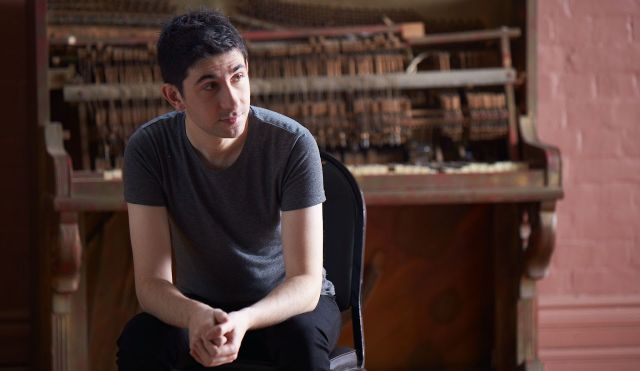
If you want proof Alex Raineri and Samantha Wolf’s long-running partnership has accrued force over time, look to Professor Good Trip. Over fifteen years as co-composers, they’ve been gathering artistic strata, shared instinct, and the kind of trust that allows two musicians to re-enter their own histories and reshape them from the inside, Their latest program, a triptych of revisitations and revelations, charted fifteen years of mutual evolution with a clarity and boldness that only deep creative kinship can sustain.
Raineri opened the evening alone at the Kawai grand, presenting remixes of Fragmentures: miniatures originally composed in 2010 and now expanded, reframed, and cross-examined through the dual lenses of time and partnership. Though brief, each miniature feels like a musical sonnet: compact yet emotionally charged, suggestive rather than declarative.
Raineri’s pianism was — as ever — fiercely articulate. He navigated the reimagined terrain with the precision of a composer-performer who genuinely understands where the bones of a work lie. The textures ranged from stumbling dissonances and jazz-inflected fragments to long, thunderous bass sonorities cradling delicate droplets of treble. At times the music bore the exploratory asymmetry of mid-century modernists; elsewhere the urban momentum evoked Stravinsky’s Infernal Dance, Danny Elfman’s propulsive cinematic currents, or the tightly coiled suspense of Herrmann.
Just as the energy reached saturation point, the music would pivot: sustained chords stretched like slow breath, unexpected minor harmonies slipped in sideways, quaver passages raced with whispered insistence, and fierce chordal stabs split the air. Raineri handled each turn with sophisticated control, balancing attack with poise. In one dizzying passage of rapid-fire high notes — buzzing, blinking, almost without beginning or end — the sound seemed to emanate not from the piano but from inside the listener’s own skull. It was a thrilling opening: restless, searching, and dynamic.
The second work expanded the performance space into something closer to a multi-media installation. This re-rendering of The Binds That Tie Us drew its energy from the interplay between live performance, manipulated archival footage, and an electronic soundscape shaped by distortion, compression, and glitch.
On screen, dancer and choreographer Gemma Dawkins and Raineri appeared to be playing some unknown game, eggs cracked, rolled, shells walked upon, and crushed. Their earlier 2016 collaboration unravelled and reassembled through a digital lens as gestures looped, jittered, accelerated, and rewound. The editing destabilised not only the visual narrative but the acoustic one, making the audience constantly question where a sound originated; from the film or the live piano.
What emerged musically was a delicate, mercurial weave. Raineri’s live part skimmed between pointillistic utterances, timbral experiments, and crystalline high sonorities that hovered like mist. The electronic layer consisting of chirps, whirs, granular glitches recalled the spirit (though not the syntax) of early electroacoustic pioneers. The overall effect was of a work that examines memory not as a fixed record but as an unstable artefact, refracted again and again through time, technology, and the bodies that inhabit it. The closing moments, with the piano twinkling like distant bells, were particularly touching.

The world premiere of Professor Good Trip was both the most expansive and the most mischievous in the program. Each movement represented an aspect of drug use: 1) Caffeine, the Rebel 2) Codeine, the Comforter 3) Methylphenidate, the Illuminator 4) Psilocybin, the Trickster 5) Alcohol, the Siren. Presented as a response to Romitelli’s Professor Bad Trip, Wolf’s score leaned into multimedia as a potent dramaturgical tool, pairing each movement with animated visuals that oscillated between abstraction, humour, and neurological suggestion.
Caffeine, the Rebel set the tone with on screen stark monochrome cross-hatching, the sound of ticking clocks and alarms, and a piano line that wandered, found its footing, then surged into caffeinated urgency. Raineri’s playing here was particularly taut: rhythmically alert, harmonically incisive, and crackling with the thrill of acceleration.
During Codeine, the trip deepened. Raineri reached directly into the piano, coaxing growls, harmonics, sighs and scrapes while the screen pulsed with vertical light bars and planetary rings in skewed colour palettes. The work’s futuristic sheen — a kind of neon-lit speculation on psychotropic history — was compelling; at one point, the score evoked the rumble of an engine yet to be invented, sweeping past in a prolonged doppler smear.
Next, Methylphenidate, the Illuminator gave us glimpses of brightly coloured neuroimages flickered on screen as a high pitched mechanical sound akin to a dentist drill was overcome by a cinematic, tense, dramatic piano part. Wolf’s writing slid between extended techniques, mechanical whirrs and high-tension pianism with almost diabolical elegance. Hints of Herrmann, Stockhausen, even Shostakovich floated through the texture.
Psilocybin, the Trickster delivered a moment of pure comic release: rainbow smiley faces, electronically warped laughter, plucked piano strings, and the performers trading corny jokes. It was a reminder that new music is, at its heart, a social act; playful, human, and fuelled by friendship.
The final movement shifted again, pairing spoken-word reflections on whiskey with a throbbing electronic bass and a fast, rave-like undercurrent. The piano entered its most explosive mode: percussive chord attacks, ferocious accents, and a barrage of rhythmic punches executed with remarkable stamina and control. As earlier visual motifs returned and gradually dissolved into black, the piece exhaled into the silence of a trip concluded.
Wolf’s writing continues to expand her already formidable range, interlacing acoustic and electronic worlds with intelligence and emotional acuity. Raineri’s performance was a masterclass in contemporary pianism: fearless in attack, refined in colour, and unerring in structural instinct. Together, they offered a concert that was a powerful testament to what sustained collaboration can achieve. If this is where the first fifteen years have landed, the next chapter promises to be extraordinary.
Kitty Goodall
Subscribe to our E-Newsletter, buy our latest print edition or find a Performing Arts book at Book Nook.