

Sainting Joan
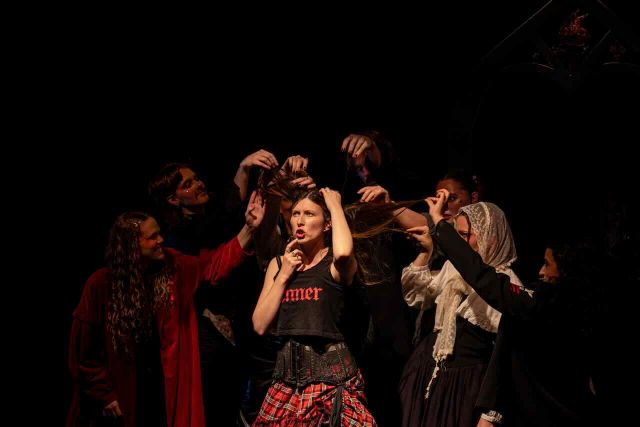
Abigail Banister-Jones is a bad-ass woman who likes to write about bad-ass women from history. Having already published a debut novel which rewrites the myth of Leda and the Swan from a feminist perspective, she has written and takes the title role in this new musical on the subject of Joan of Arc. Her commitment to the role is such that during the season she has progressively cut her hair on stage.
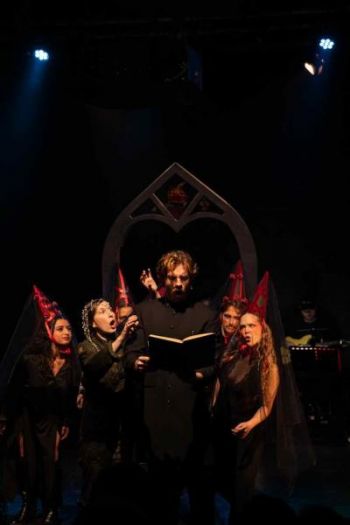 Banister-Jones has set this retelling of Joan's life 500 years after her death during the event of the 1920 canonization. Every witness to the procedure is a ghost; significant individuals from the past who re-enact cheeky vignettes of what transpired. Most significant of those is King Charles. The political trial of the C15th which condemned Joan as a heretic, implicitly invalidated Charles’ coronation. He is as much invested in the outcome of the trial as Joan, becoming the Aaron Burr to Joan's (Banister-Jones') Hamilton. Charles is the anti-hero whose resentment and bitterness drives the narrative as much as Joan's passion to follow her visions. Both characters are beleaguered by doubt and certainty. The other five cast members play numerous characters all of whom are clearly defined in this truly ensemble piece.
The show is entirely sung-through. Lachlan Obst as Musical Director and Arranger does an exceptional job conducting from the keyboard. The pace of the show is dictated by energetic choreography and the tight band. The music is a fusion of punk, folk, and rock with musical theatre numbers evocative of jazz and show-tune numbers. Charles’ introduction ‘Who am I?’ evokes 'You Are the Christ' from Jesus Christ Super Star or 'What did I Miss?' from Hamilton. The opening choral overture showcases the ability of the ensemble to navigate harmonies. Obst is versatile on the keyboard utilizing organ and harpsichord sounds as appropriate and keeping the motifs and themes of the piece in the forefront, making a coherent whole of the eclectic style. The drumming (Victoria Mertonidis) is on point and the guitars (Timothy Chivers, with Lou Hogue on bass) versatile.
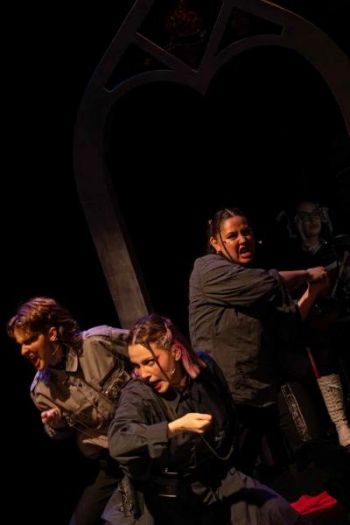 The structure is satisfying. Joan's motivation is established early in a song of exposition. With a military beat featuring complex footwork, it evokes her inexorable march to the stake. Joan must follow the voices that determine her destiny. Charles is concerned with redeeming his legacy and is tormented by his actions. Was he culpable in what transpired by abandoning Joan to the English? All characters are flawed. Charles is selfish; Joan is overly ambitious. Banister-jones makes the point that a hero does not have to be saintly to be an inspiration or role model.
The immolation of the titular character is not the climax of the story. After Joan is burned at the stake the story continues. Charles' son attempts a usurpation of the crown prompting Charles' to revisit charges get of heresy against Joan. Joan is given the opportunity to speak again about the ways in which life can mistreat but posterity can redeem in a moving ballad of forgiveness.
The whole cast is excellent and well matched in voice, harmony, comedy, and choreography. Emerson Hanford (Charles) has a powerful and versatile voice and a mastery of comic timing. The physical characterisation of the role is excellent. Bec Shilling is strong as Joan's mother, Isabelle. Cassie Ogle (one of three ex-pat Tasmanians in the ensemble) and Gemma Caruana have excellent comic instincts and powerful voices. James Colbourn-Keogh (also ex-TAS) is the bass of the ensemble bringing gravitas to the role of Devil’s Advocate and humour to their many minor roles. Their song ‘Devil’s Advocate’ was a crowd pleaser. Banister-Jones has a pleasingly light voice well-adapted to folk ballads. Riley Street shows themself to be a consummate performer in various roles. They were excellent as Prince Louis and as Joan's one-time beau. Street is somehow both magnetic and repulsive in vaudevillian makeup. Brittany Ng, Caruana and Street shine in the memorable song ‘One More Minute' in which three members of the demoralised French army revel in their depravity and are chastised and inspired by Joan. This is a song which highlights Banister-Jones’ wit and way with words.
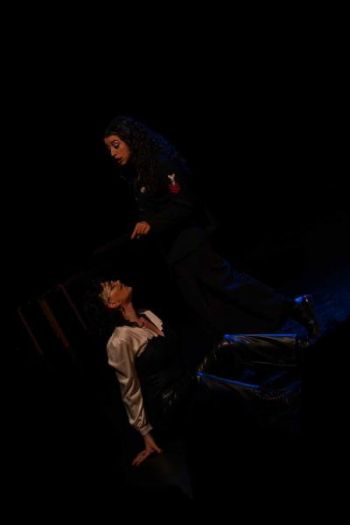 Overall, the voices were all strong but might have been better supported
by the sound design. The lighting plot was complicated and sometimes behind the cues in such a fast-moving show. The lighting was evocative of the darkness of the period in which it is set and the ghostly nature of the characters; elusive, half-hidden, seen out of the corner of ones' eye. The choreography was sharp, unusual, and entirely appropriate. Costumes were in a palette of red, black, and white reflecting contemporary gothic and making good use of gauze. Lighting, costume, music, and choreography contributed thoughtfully to the essence of the story being told.
In a collaborative production with Theatre Works, Banister has been able to share investment and risk in a supportive environment. Theatre Works assists more than 600 independent artists each year in this way. As a Tasmanian, this reviewer wished such a facility existed in their home state.
At the end of final night, I grabbed a holy relic of Joan’s hair. I am sure to make a fortune from it in years to come.
Anne Blythe-Cooper
Disclaimer: Anne Blythe-Cooper is on personal terms with several of the cast of Sainting Joan.
Photo Credit: Iz Zettle
Subscribe to our E-Newsletter, buy our latest print edition or find a Performing Arts book at Book Nook.