

Sing Sing Sing
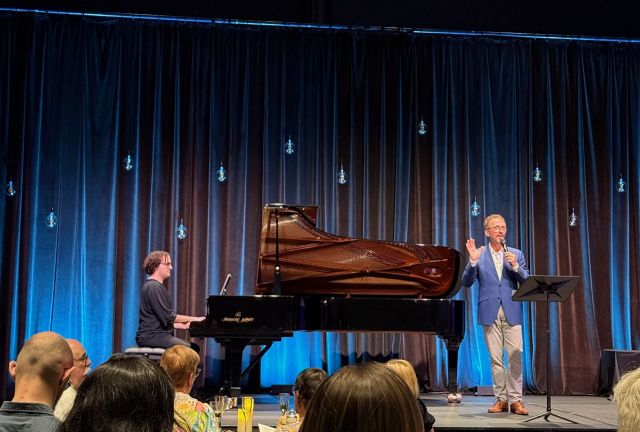
Opera Queensland’s Sing Sing Sing continues to prove that participation can be every bit as artistically satisfying as observation. This is not opera as a museum piece, preserved behind glass and admired in silence. It’s opera with its collar unbuttoned a little, handed back to the room, and all the better for it. Always well attended, and clearly building a loyal following, the event has found a sweet spot between musical substance and social ease. The chance to arrive early, take a complimentary drink in hand and chat before a note is sung is not incidental to its success. It is part of the architecture of the afternoon, creating the kind of relaxed welcome that makes newcomers feel included and returning singers feel at home.
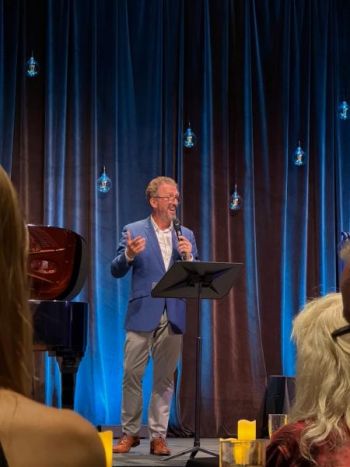 The format is elegantly simple and smartly judged. After around half an hour of social time, baritone Jason Barry-Smith leads the room through a vocal warm-up before guiding the group through a selection of operatic favourites that are taught and then sung together. The programming is different each time, which keeps the concept fresh, but the underlying structure remains dependable. It offers just enough scaffolding for nervous participants and enough musical interest for experienced singers. In an arts landscape where people are often invited to consume culture passively, there is something quietly radical about an event built around collective contribution. Sing Sing Sing understands that people don’t merely want to admire singing; they want to do it.
Barry-Smith is central to the event’s buoyancy. He hosts with an easy, generous command of the room, and his greatest skill lies in making participation feel both playful and safe. He has humour without smugness, authority without stiffness, and a strong instinct for pacing, knowing when to explain, when to encourage and when simply to let the room sing. That sense of balance is vital in a participatory format, and he handles it deftly.
At the piano, Luke Volker provides accompaniment of real polish and flexibility. His playing has a conversational quality to it: responsive, stylistically fluent, rhythmically alive and unfussy in the best sense. He supports rather than dominates, shaping the room’s confidence with clear musical cues and an instinctive feel for collaborative performance. His rapport with Barry-Smith also helps keep the tone warm and grounded, which matters enormously in an event where the audience is also the ensemble.
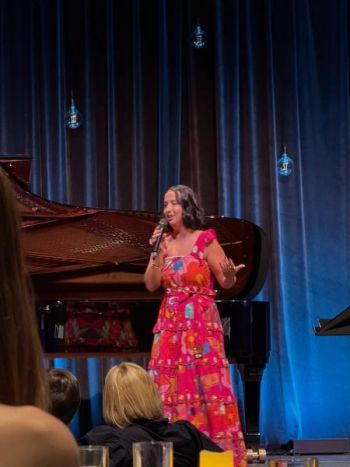 Midway through the program, the audience is given a brief rest from singing to hear Gabrielle Diaz perform Luigi Arditi’s Il Bacio, and it is a welcome reminder that lightness of spirit need not come at the expense of technique. Diaz, a Brisbane soprano with Opera Queensland credits and formal training at the Queensland Conservatorium, has also worked across both classical and crossover repertoire, and that versatility serves her well here. Her performance of Il Bacio was bright, nimble and charmingly assured, capturing the piece’s flirtatious sparkle without overplaying it. The coloratura sat cleanly, the line remained buoyant, and the comic fizz of the piece was delivered with a pleasing sense of style.
What makes Sing Sing Sing so effective is that it refuses the false choice between quality and accessibility. It is not anti-excellence, nor is it interested in opera that takes itself so seriously it forgets to be human. Instead, it leans into the communal pleasure of singing, the thrill of voices joined in unison, and the strangely uplifting fact that one of those voices is your own. That is a brilliant concept, but more than that, it is a well-executed one. With thoughtful curation, strong musical leadership and a genuinely welcoming atmosphere, Opera Queensland has shaped an event that honours the art form by letting people inside it. Sing Sing Sing is not merely enjoyable. It is a reminder of why people gather to make music in the first place.
Kitty Goodall
Photography by Kitty Goodall
Subscribe to our E-Newsletter, buy our latest print edition or find a Performing Arts book at Book Nook.