

Soul of Possum

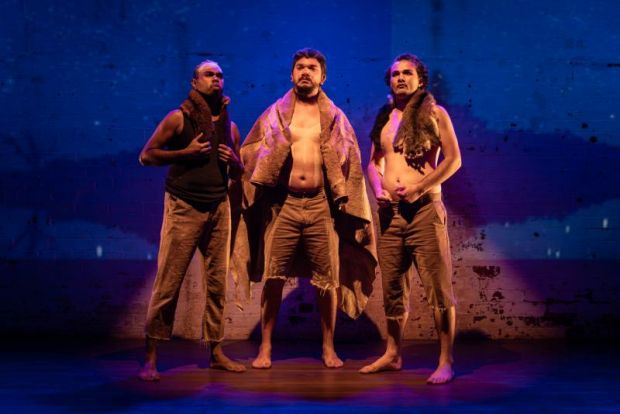
1853. Three warriors advance across country. One, Marnuu (Bela Neba) is of a different tribe from the other two, Barru (playwright Brodie Murray) and Gundi (Wimiya Woodley). Marnuu has been warned in dreams of Possum (Tahlee Fereday in Voice Over) of a coming evil, but the other two scorn him: this is not his country, and they doubt that he has even been initiated.
The ’evil’ is indeed present. It’s waiting upstream: a British expeditionary force on a gunboat or ‘big canoe’ – as per Marnuu’s dream - is moored by the riverbank. The irony is that these whitefella invaders and conquerors, so superior to the ‘natives’, are deeply flawed and blinkered human beings, riven by their own conflicts.
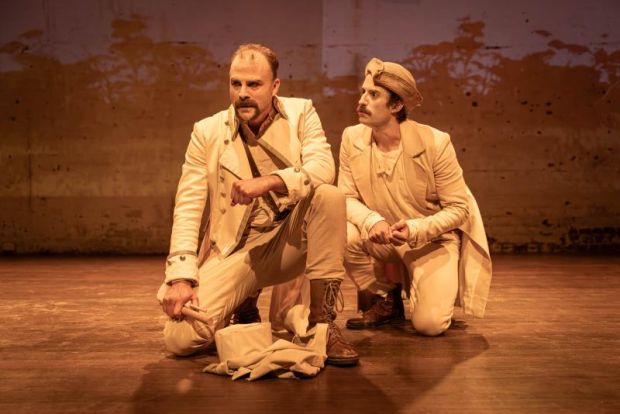
Captain Cooper Gibbins (Leigh Scully) is out of his depth and falling apart. Lieutenant Lachlan Bankes (Gabriel Partington) is cruel, a liar, and horny; he anticipates kidnapping native women as sex slaves. In the meantime, he has his lustful eye on the powerless convict servant Willard Yates (Luke Mason) whom he persecutes (shades of Melville’s Billy Budd).
Observer and early anthropologist Dr Anthony Wilkins (Kevin Dee) maintains a calm objectivity and minimises difficulties by studying maps and taking notes, his blinkered vision suggested by his sunglasses. All are fretting and frustrated at the practical uncertainties of their mission, their incomprehension of the ‘natives’ and this unfamiliar, forbidding – to them - country. They are there, of course, to open the country for the Empire – and there is, really, only one way to do that. Shades here of Conrad’s Heart of Darkness or Outpost of Empire in which greed, alienation and fear turn the Europeans to hatred and violence.
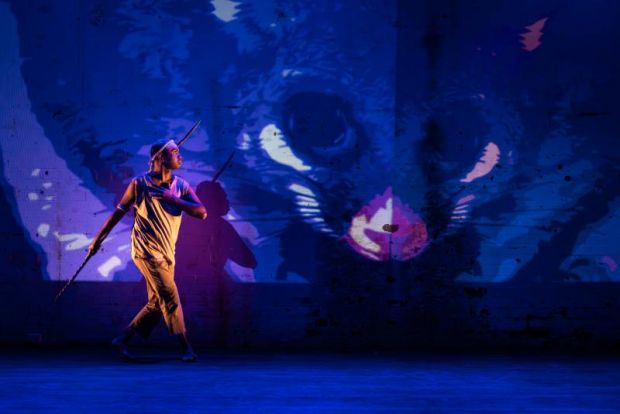
Their location on the river, as depicted in the giant projections by Shane Grant of the Murray River by day and by starry night across the theatre wall, and B J Keene’s soft soundscape, is beautiful and bountiful, but the invaders can’t – or won’t – see that.
An outstanding element is non-narrative. It is Bela Neba, dancer as well as actor, gliding gracefully across the stage, spear at the ready, a figure entirely alert yet entirely at one with this place, this Wamba Wamba Country.
It’s interesting to compare the 2021 production of Soul of Possum that I saw and reviewed so favourably at the Meat Market in North Melbourne. There have been some minor changes on the one hand, while, on the other, some less felicitous aspects have remained the same. Adrienne Chisholm’s whitefella uniforms are now white, and the characters’ ethic whiteness is emphasised further by white make-up. But whether changes are due to Brodie Murray’s further development of his play, or the continued participation of dramaturg Declan Furber Gillick, or director Beng Oh adapting to the smaller fortyfivedownstairs space, we can’t say.
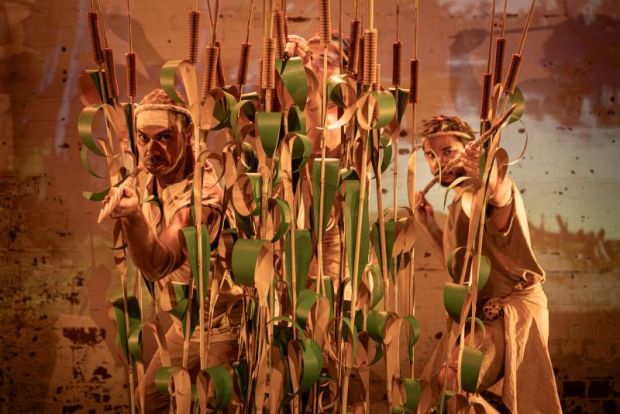
Soul of Possum is a thought-provoking piece that refuses to romanticise our history as it juxtaposes Anglo and indigenous responses to invasion. This beautiful river will be a massacre site. But in the end, as an epilogue set in the present tells us, it is a story of the survival of a people and their history.
Michael Brindley
Photographer: Darren Gill
Subscribe to our E-Newsletter, buy our latest print edition or find a Performing Arts book at Book Nook.