

Titus Andronicus
When victorious General Titus Andronicus (Josh Morrison) returns to Rome from a ten-year campaign against the Goths, he brings with him Tamora, Queen of the Goths (Victoria Haslem) as booty. A spiral of mayhem ensues: murder, rape, mutilation, sacrifice, and vengeance – principally vengeance.
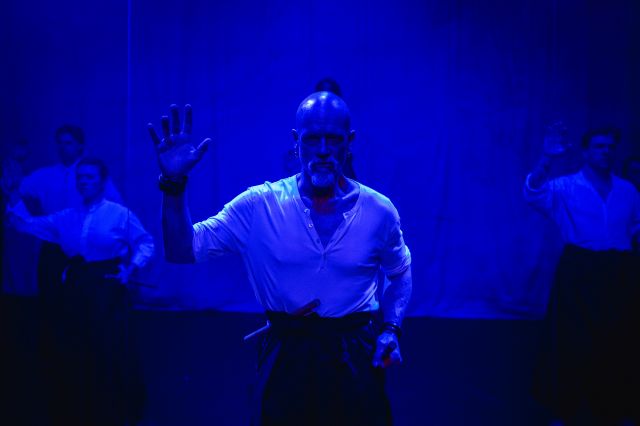
This production of Shakespeare’s most graphically violent play is stylised, almost ritualistic – and therefore abstract; its approach and tone are brilliantly set from the start. As the lights slowly fade up, we see the whole cast of thirteen as armed Japanese warriors in wide, black Hakama pants and white shirts. They move with a menacing synchronicity – frightening but strangely beautiful. Why this ‘Eastern’ mode? Because it distances the story from ‘ancient Rome’ and places the emphasis elsewhere, establishing an eerie style that prepares us for what follows.
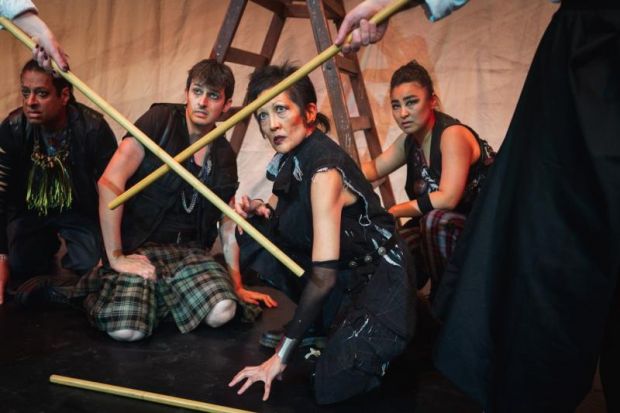
While the Romans maintain their dress code, the Goths are, well, Goths – all in black, a ragged mix of styles festooned with sharp objects. It’s a clever distinction: the captured Goths are spoils of war, disrespectful, cruel, louche, rebellious and out for revenge, urged on by the murderous Moor Aaron (Rajendra Moodley), Queen Tamora’s lover. Haslam’s Tamora is a snaky, creepy but sexy femme fatale, cuckolding Emperor Saturninus without a qualm.
The Romans, meanwhile, are not so virtuous, torn between duty and, yes, revenge - riven by power struggles, jealousy and the same ruthlessness and selfishness that hangs over every scene. Scott Jackson plays Emperor Saturnius as a grinning idiot while his brother Bassianus ((James William) is an easy victim.
Shakespeare’s play was hugely popular in its day, then out of favour for centuries, and brought back by director Peter Brook in 1957 and since then performed semi-regularly. We could ask ‘why?’ – and ‘why now?’ If we stand back from this particular stylised production, we must say that Titus Andronicus is not a great play.
Unlike Shakespeare’s other ‘Roman’ plays, Titus Andronicus is all invention, a fiction, set in an indeterminate period, assembled from bits and pieces of myth and history, by a young playwright who wants to make a splash. He succeeded. Even so, Shakespeare’s genius is already more than discernible in the characterisation and the poetry of the language. But in this play, each barely plausible plot development is a set-up for more horror, more murder, more blood, that can only make sense in an amoral world – a world of an eye for an eye, a tooth for a tooth.
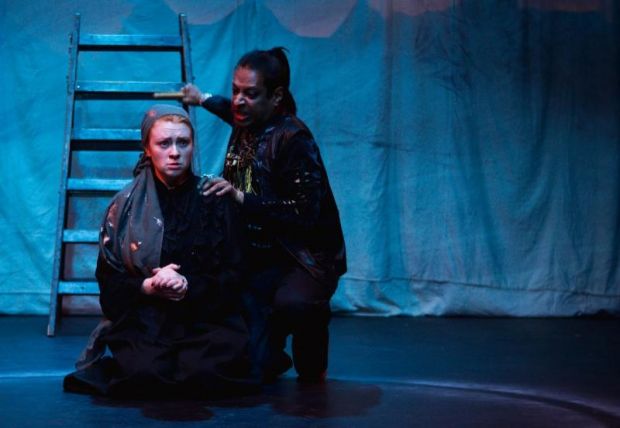
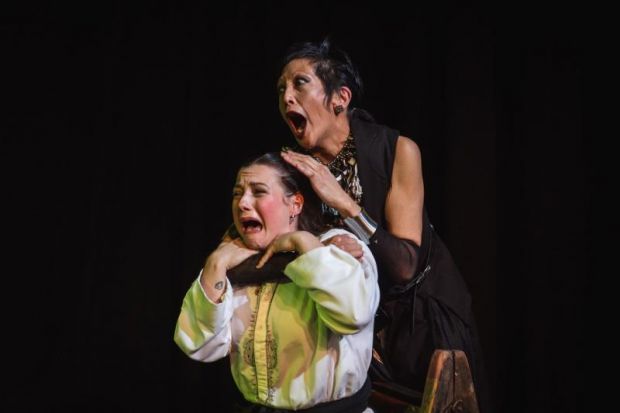
Hopkins and Nicholls have done a slick and clever edit of the play, bringing the text down to a fast-moving, gory ninety minutes that maintains context and plausible motivations. But they have resisted any temptation to camp it up or to revel in the horror for its own sake. We don’t have the gratuitous bloodshed of some horror flick. It’s clear in the program interview with them that they take the play absolutely seriously, insisting on its relevance - and they imbue their production with their seriousness, making us take it seriously too. What happens on stage maintains that ritualistic feel (the stage is bare except for three trestle ladders) and the choreographed movements suggest animals circling for the kill.
As the story proceeds, Josh Morrison’s Titus is bizarre fun to watch as he moves from stoic Roman to increasingly deranged but inventive revenger – a manic horror movie villain justified in his rage. In keeping with the stylisation, the blood that pours from mutilations is represented by flowing red ribbons. It is only in the play’s final moments, when there are so many murdered bodies on stage that some in the audience laugh involuntarily at the excess and near absurdity of it all.
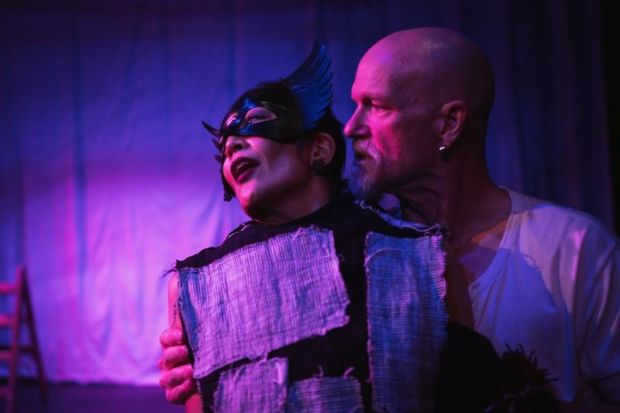
It might help to read a plot summary before going in, but despite the convoluted plot and the very fine cast of thirteen playing twenty-four characters, including gender crosses (Helen Hopkins is particularly strong as Titus’ brother Marcus), you can follow the fast-moving over-heated horror on stage – and be engaged, amused and even moved. As we walked down the slope to the tram, the Companion remarked that this Titus was the best theatre show of the year.
Michael Brindley
Photographer: Steven Mitchell Wright
Subscribe to our E-Newsletter, buy our latest print edition or find a Performing Arts book at Book Nook.