

Turandot
Written in 1924, Turandot was Giacomo Puccini’s very last opera. Set in China, it tells of the icy princess Turandot who seeks to avenge the barbaric humiliation of her ancestor Lou-Ling by cruelly executing any suitors that cannot answer three esoteric riddles. And Calaf, the exiled Mongolian prince, who falls in love with her, and despite all advice, determines to win her.
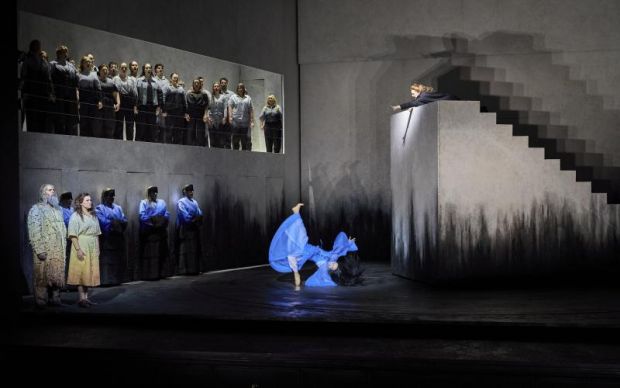
Director Ann Yee describes the theme as “pain healed by love” where “the journey from one to the other is laden with high stakes, intrigue, death and huge spectacle.” In Yee’s directorial vision, Lou-Ling lives so vividly in Turandot’s psyche that she is one of the cast. Depicted by dancer Hoyori Maruo, she appears in a prologue fighting for her life and her kingdom in an incredibly graphic, almost grotesque piece choreographed by Yee.
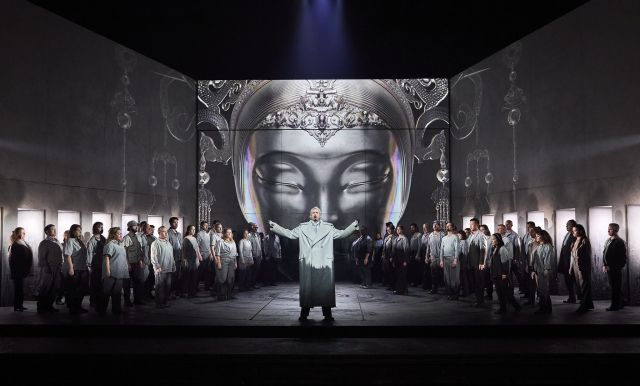
Princess Turandot appears beside her, wrapping her arms around her and rescuing her crown, which she places on a huge avatar of herself – another of Yee’s contemporary innovations – which is projected over her people to show she is still in control despite her emotional pain.
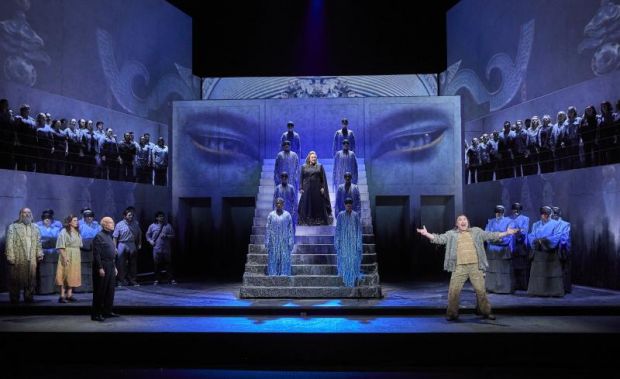
The avatar, created by Andrew Thomas Huang and animated by artists from Collider productions, is a vigilant, protective presence projected on the high, solid, grey walls that encompass Elizabeth Gadsby’s imposing set that is Turandot’s domain. The huge staircase on which Turandot appears revolves to become her headquarters where her administrators, P1, P2 and P3, preside.
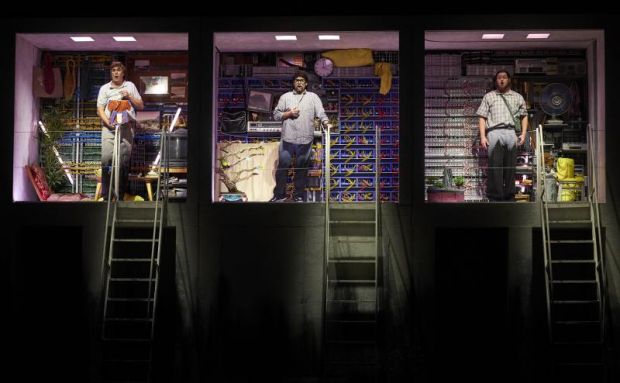
This is the only light moment in the opera, and the three Ps – Luke Gabbedy, John Longmuir and Michael Petruccelli – sing about the grisly fate of the unlucky princes who have already met their deaths, while they potter about in three quirky workshops that Gadsby sets high above the stage.
As the crowd gathers below to watch the execution of the latest prince to fall victim to Turandot’s strange riddles, Calaf appears and finds his blind father, Timur, and Liù, the servant who has been faithful to him in his exile. It is here that Calaf first sees Turandot, pledges to win her, ignores the advice of the three Ps and the loyal Liù, and strikes the huge on-stage gong that announces him as Turandot’s next suitor.
Ann Yee, who had not heard of Turandot until 2022, describes the music of Turandot as “truly transformative, universal and breathtaking”. Whilst Calaf’s Act 3 aria ‘Nessum Dorma’ is so well known, the opera itself, written for a full orchestra with the addition of 13 tuned Chinese gongs, shows Puccini’s continued use of more modern musical techniques including driving rhythms like those in Turandot’s aria ‘In questa reggia’ where she sings about the death of her ancestor, and softer, lyrical motifs like those in Liù’s sad aria in Act 3.
In ‘Ah! Per l’ultima volta’ (Ah, For the Last Time) Timur, Liù and the three Ps warn Calaf about his bid to win Turandot. It begins with a quartet, moves to a sextet and eventually involves the whole chorus. This is a remarkable piece of music and Yee makes it a dramatic theatrical moment, a stunning coming together of music, voices, movement, costumes and visual effects.
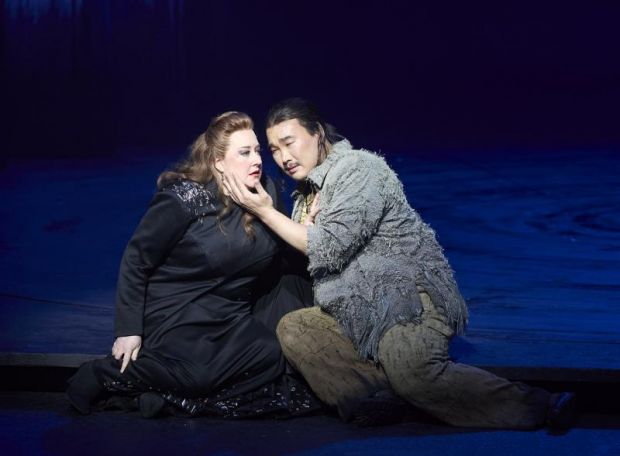
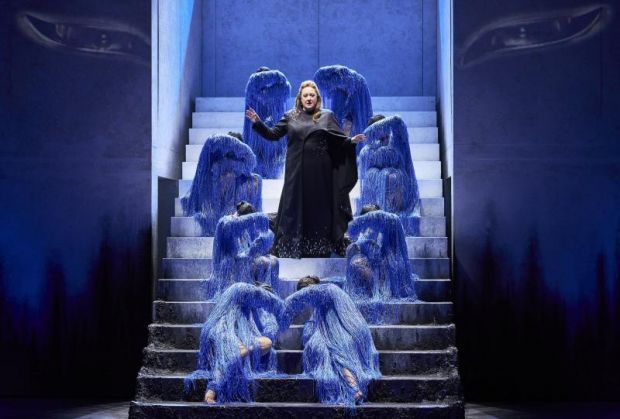
Australian soprano Rebecca Nash returns ‘home’ to play Turandot. In a flowing, dark costume designed by David Fleischer, she finds the despair and trauma of this haunted heroine, icily refuting love in some of Puccini’s most moving music.
Korean tenor Young Woo Kim brings great vocal power and emotion to his portrayal of Calaf, touchingly caring with his father and the gentle Liù, but defiantly determined in his quest to win the love of Turandot.
Maria Teresa Leva is the devoted Liù, her singing, and her acting, giving the character a fragile strength that infuses the story. She is caring, understanding and selfless, as her final moments show.
Yee saw the characters of Lou-Ling and Liù as pivotal in teaching Turandot about life – Lou-Ling about “the innocence, value and pain of life,” Liù about “the freedom and strength of love”. And it is Lou-Ling in bright aqua chiffon and Liù in her simple peasant costume who rise up above the shoulders of the chorus in the final moments of this new, spectacular production of Turandot.
The collaboration between creatives is integral to any production, and that fusing of creative visions is a distinctive feature of this production. Colour and contrast in the costumes and the set, is picked up and highlighted creatively by lighting designer Paul Jackson. David Fleischer’s costumes pay tribute to Puccini’s aim to compose inspiring music about ordinary people. He dresses the chorus and the dancers in blue work clothes, dark trousers, but lighter shirts and coats. In crowd scenes that lightness on the chests and shoulders is picked up by the lighting, uniting the performers in a blue haze that highlights their faces as they sing.
The principals, apart from Turandot and the ancestor, are dressed in muted shades of grey, green and blue flecked with shiny threads that reflect the light. Turandot’s attendants – and the children’s chorus – dressed in shining blues contrast with the muted atmosphere of the set and the mood of the story – and the towering avatar that presides over much of the production.
Ann Yee brings a fresh, new approach to this opera that has been thrilling audiences for nearly 100 years. Her interpretation adds new dimension to the story without losing any of its original power and emotion.
Carol Wimmer
Photographer: Keith Saunders
Subscribe to our E-Newsletter, buy our latest print edition or find a Performing Arts book at Book Nook.