

Vanya, In Our Time

It’s a beautiful summer evening and the small crowd gather beneath a tree, its rustling, dry leaves the only sound atop the vista overlooking the city of Adelaide. A man sleeps peacefully on a bench, woken only by a car that pulls up in a hurry, and a young man runs out towards the imposing house beyond.
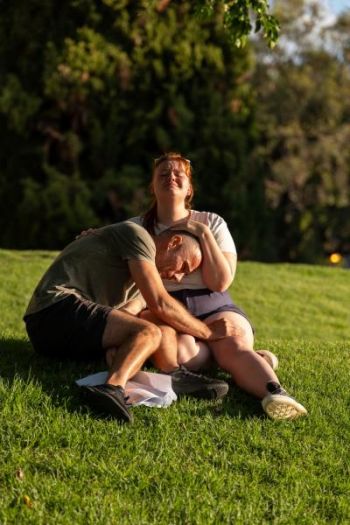
It’s a cracking start to this adaptation of Chekov’s Uncle Vanya, reset to twenty-first century Australia and adapted workshop-style by director James Watson and his small cast during a residency at Carrick Hill. The immaculate lawns, hidden holes in tall hedges, and secret arbours are the perfect setting for this immersive theatre experience, where the small audience is guided to each location with the performers moving fluidly between the rose bushes and orchard fruit trees. It’s almost cinematic, with each audience member creating their unique tracking shot of the action as it moves through the garden and into the house – the impressive Waterloo staircase becoming a stunning set for the second act.
The core story hasn’t changed from the original play: a retired professor remarries a much younger woman, Yelena, and moves to the rural estate inherited from his previous wife after her death. It’s managed by the late wife’s brother and daughter, Vanya and Sonya, whilst a young doctor Michael Astrov regularly visits the ailing professor in his self-imposed bedrest.
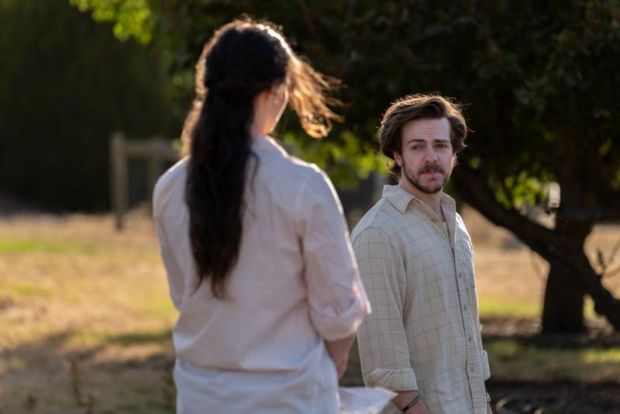
Matt Hyde is the titular Vanya – the sleeping man on the bench – and on the surface, he is laid-back and happy with his life looking after the trees and plants of the estate. Hyde’s skill is in the slow and painful reveal of his true unhappiness, lost love, and a world changing around him whilst he just wants to keep doing what he’s always done.
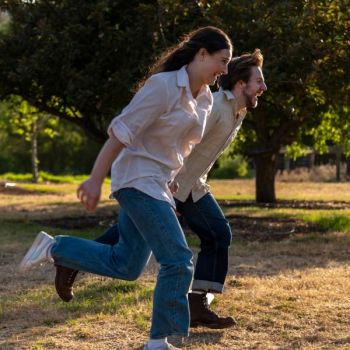
James Starbuck bounds from the car into the scene as Michael, the doctor. Starbuck is great as the idealistic physician, immensely emotional about death and the environment, not so much about romantic love. Starbuck brings Michael alive with passion for his conservation – and particularly, in his scenes with Vanya: a bromance beautifully yet tragically realised.
Emelia Williams is the young Sonya, looking for love and validation from everyone else, without much returned. Williams is at her best here, bringing to life Sonya’s cheeky innocence that’s being slowly cracked apart by the reality that almost no-one notices her for who she is. Her emotional range is superb, bringing the audience closer through every smile and tear-filled eye.
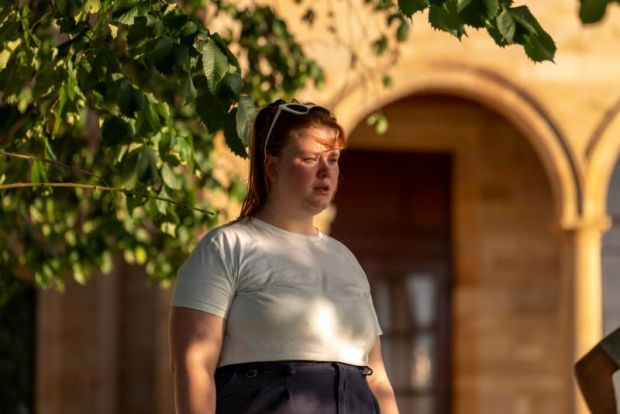
Yelena is played with such power by Kate Owen – the new wife clearly holds most of the authority in the house, yet Owen is terrific in stripping this back to Yelena’s discomfort beneath, at being a wife the same age as her stepdaughter, in a family home she’s never known, amongst others whose love is misdirected. Director Watson never allows Yelena the easy path to superiority, ensuring her uncertainty is never far from the surface – indeed, she is never so dominant in a scene to the extent that the others become set dressing.
 In previous Famous Last Words’ productions, Owen has played brilliant roles whose characters are superior to the others – particularly in Miss Julie (After Strindberg) and the stunning re-imagining of The Maids – but Yelena is much more exposed. Here, Watson has crafted an intimate ensemble whose social standings may differ, but their emotions flow between all four equally – and it’s not just the audience’s physical proximity that means they feel this. There’s a stark vulnerability in each of Vanya, Michael, Sonya and Yelena: the struggles can be seen on their faces, the emotions heard in their voices.
The retired professor is never seen – yet is always a presence in every room and beneath every tree. And of course, the location is a wonderful character in the drama too: perhaps Carrick Hill is not exactly a rundown rural property, instead its well-trimmed gardens and polished house show the vanity of physical attraction, when the real value is in the lives of people that care for the estate – maybe more than they do for each other.
The unfolding of the story and its opportunities of love lost at every turn is wonderfully told by the foursome and guided firmly by Watson. Such is the universality of Chekov’s play that you don’t need to know the source material to appreciate this interpretation. There’s whimsy and comedy, drama and tragedy across the seventy minutes, and the audience’s full immersion into this doesn’t break as they journey between scenes – the story never stops.
It's a risk artistically and commercially to create a production this way, with limited numbers each night restricting ticket sales (though the entire season is already sold out), but it is the right choice: less is more here. A larger audience would reduce the sense of reality felt amongst the trees, and this is a play that demands immersion.
Review by Mark Wickett
Photographer: Philiposs Ziakas
Subscribe to our E-Newsletter, buy our latest print edition or find a Performing Arts book at Book Nook.