
Come From Away CLOC Musical Theatre

Director’s Diary: Rob Robson
After 25 years as the manager of a major regional arts centre, Rob Robson answered the call to direct the Australian non-professional premiere production of Come From Away at Melbourne’s largest community theatre, CLOC Musical Theatre.
When news came through that CLOC was chasing the rights to stage a production of one of my favourite recent musicals, Come From Away, and they wanted me on the team, I became very excited.
A lifetime ago I directed three shows for the company, but had spent 25 years helping other people put shows on.
After much persistence, came an answer. “You have the pre-release rights, but we require you to do a replica version of the professional production.”
Was I up for it? Of course, I said yes. Welcome to the Rock … and a hard place.
 Director’s Vision v The Bible
Directing previous shows had allowed me freedom to bring a director’s ‘vision’ or re-interpretation to each production.
But we were given ‘The Bible’ for Come From Away. Just a replica Broadway or Westend production when it comes into Melbourne or Sydney.
How does a ‘Director’ express a vision in this instance? No space for ‘re-interpretation’.
Time to dig a little. The structure and ‘look’ of the show is set but at the heart of it is how each actor can bring the voices of these REAL people and these ACTUAL events to life in front of a new audience every night.
In live theatre, no two performances are ever the same. There is a dynamic between performer and audience that pushes and pulls so each performance is unique. The text, the setting, the blocking, the music, might all be set out in the ‘bible’, but what is not there is the unique quality of each individual playing the parts. That’s where the director’s vision can come into play.
Come From Away is not a typical musical. It’s an extraordinary story about ordinary people. Based on verbatim interviews and set in the immediate aftermath of an act of inhuman terrorism, this is a story that celebrates the very best in people and communities.
 I was blessed to work with a fantastic team - MD (Malcom Huddle) and Choreographer (Tailem Tynan) - who shared the vision. Our roles overlapped. Most dialogue has an underscore, songs are interspersed with spoken narrative, choreographing the movement of chairs and props is as crucial as moving actors, and all changes of the set are carried out by cast. The band is on stage and enter the action at times. This show very much blurs the traditional responsibilities for the production team.
‘The Bible’ helps (and sometimes hinders!), but it only takes you so far. There is still an important creative role for the production team.
So, these were my Direction Maxims for this show:
Make it real.
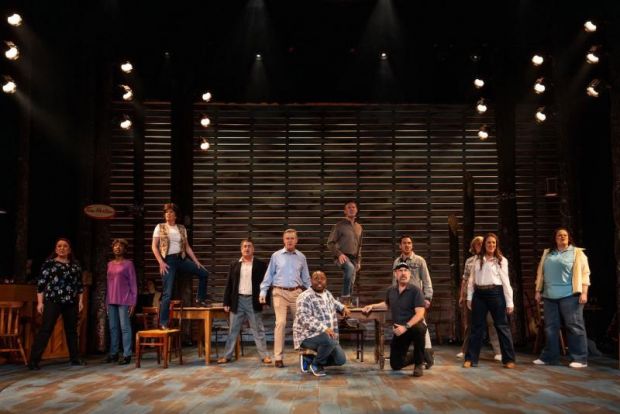
The cast need to always look and sound authentic. Physical diversity, appropriate age range, respectful cultural representation, dialects and accents, all need to ring true. The actors break the fourth wall and address the audience directly. The show calls for the 12 actors to play multiple roles, often with only a change of stance, hat or accent to differentiate one character from another. As director I found myself testing the truth of each moment and every bit of ‘stage business’. “Does this make sense? Is it real?”
Less is more.
Experienced music theatre performers know how to give something that little extra kick. But if we want the audience to believe the actors are ‘real people’, sometimes they need to pull back a bit. Musicals often call for larger than life. This one is about being ‘ordinary’! A typical director’s note from me was, “Great, but can you give me that at half strength please?”
It’s about community.
The show is a celebration of community. It offers an antidote to terror and fear. The cast, band and crew need to work as an ensemble, to be a community.

Auditions
There was a buzz around auditions. The company was proactive in reaching out to non-typical and diverse potential auditionees.
The task of selecting a cast of twelve from a pool of nearly two hundred auditionees was daunting.
Here was a show with fantastic roles for older actors. Only two or three of the roles are a good fit for the ‘20 somethings’. Some of the roles have specific cultural profiles. This was going to be a test of how ‘culturally diverse’ Melbourne’s non-professional music theatre community really is.
The team set the audition room up as a comfortable space. We used socials to give people familiarity with the process ahead of the auditions. Every auditionee was welcomed and thanked, sincerely.
We were looking for capability (of course), flexibility, balance, compatibility and diversity. Most of all we wanted a cast that looked and felt ‘real’.
After movement calls and second looks we made the call … most of the cast had been leads in other shows. Some were also highly awarded directors themselves. No pressure, Rob! Now to build an ensemble.
Settings: “It’s JUST 14 Chairs and three tables.”
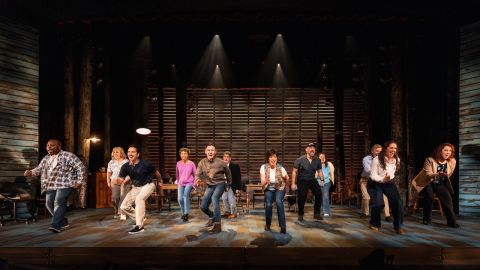
The settings for Come From Away appear to be very simple. One set with a few ‘trees’ … with lighting fixtures, a couple of neon signs attached, and a simple slat wall at the rear.
You just grab a bunch of chairs from hard rubbish night and job’s done, right? But every chair has a specific role and track in the show. They need to be distinctive but ordinary and robust to stand intensive rehearsal.
Each change of location is represented by rearranging the chairs … fast. Who moves which chair to where and when? Often it happens over a few bars or a couple of lines, and there is no escape into vamping the score. Props and costumes need to appear seemingly out of thin air. Planning and mapping the chair tracks was as big a task as setting the movements of the cast.
Then there is the revolving stage. This piece of stage kit needs to run in both directions and at very specific speeds. I loved having a set designer who could give me a fantastic set model to help everyone to understand how what we were doing in rehearsal would work in the theatre.
The first time we finally put it on the full set with the revolve, was a highlight for me, when the music, the action and the setting all came together. Stage magic built on massive amounts of trust in one another!'

Rehearsing and rehearsing
All cast were called for every rehearsal and our approach was to build the show in chunks and in run order. Because each sequence segues into the next, getting a solid feel for the flow was crucial. Sometimes it felt like a whole rehearsal might yield only a few pages. Our motto was you ‘eat an elephant one bite at a time’.
Our Props and Costumes team helped by ensuring every prop and key costume change was available in some form from first rehearsal. Highest praise to the cast who were always on top of getting off the book.
There are no off-stage catch-up moments, no interval and we very deliberately worked songs so audience applause stopped the show at only three clear moments (after the opening number, after ‘Screech in’ and at the end (we had to relent and accept the applause break after the ‘Heart Surgeons’ as well!).
The show is fast paced and drives forward with an almost relentless quality. The first time we ran the whole show felt like we had run a marathon!
Audience Response/Critical Response
‘Annette’ sings that Gander is as far as you can get from Disneyland. Come From Away is far removed from Disney Musicals. There are no flashy effects and no villains to boo. No fantasy: it’s a musical documentary about 9/11. But it’s about the best in human nature, not the worst.
It is hard not to like it, and audiences generally ‘come away’ uplifted.
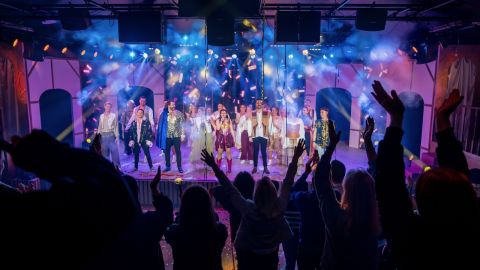
The fantastic cast deservedly enjoyed standing ovations and the thrill at bows of the band taking over the stage for ‘Screech Out’ had everyone back on their feet clapping along to the fantastic Celtic vibe. Under Malcom’s lead on keys and piano accordion, we were blessed to have a fantastic band truly part of the show.
My hope at outset for a true ‘ensemble’ show was realised and rewarded in audience comments. Critical response was equally glowing, though doing a ‘replica’ version left some feeling it lacked originality. Now on general release, companies are free to treat the show in different ways, and I look forward to seeing what they do.
It is possible to cast a larger company and not have actors playing multiple roles and I am sure the business side of having large casts will lead to that. I wonder what might be lost though. The sheer virtuosity of the quick-change role-playing is one of the delights of the show and helps drive the pace.
For myself, I was honoured to have the opportunity to direct the premiere and to work with such an awesome cast and team. It’s nice to get back to it now I have retired!
The sets for Come from Away and many other musicals are available from CLOC Costumes.
Photography by Ben Fon