
Putting a Big Show into a Little Theatre

Director’s Diary – & Juliet
Meg Day directed the Australian Community Theatre Premiere of &Juliet in a 148 Theatre on the NSW South Coast. She describes the challenges.
The Beginning
It all started with a phone call and a pretty simple question… would you be interested in directing & Juliet with the Wollongong Arcadians. I had been telling everyone that “I was having a 12-month break” but within seconds I changed my mind. The thought of directing & Juliet energised me instantly.
 The original plan was to stage the production in the 500 seat Illawarra Performing Arts Centre (IPAC), however, after much discussion, the Board decided that it was not financially viable.
As we left the meeting someone said, “Could we do it at the Miner’s Lamp Theatre?” (owned by the company)
My initial reaction was no; the show needed a big stage and an impressive set full of all the Broadway tricks. How could we achieve that on a tiny stage? How could we fly Romeo down at the start of ‘It’s My Life’? How would Juliet fly on a chandelier? It just all seemed too hard.
But the more I thought about it the more it started to make so much sense. The Globe and the Shoreditch Theatres didn’t have fancy fly towers and elaborate sets. The players moved simple set pieces on and off stage, and the audience just used their imagination. By the time I was home, I knew that we could transform the Lamp into a mini-Globe where we could transport the audience from Corrimal to Verona and then on to Paris. We just needed the agent - Music Theatre International to approve our plan.
Vision and Design
For me the core question of & Juliet is “What if things didn’t have to be this way? What if we didn’t limit ourselves to the social expectations of our time? What happens when we challenge, accept and celebrate things being different?” When we choose to be ourselves and live our life our way, we have the most joy.
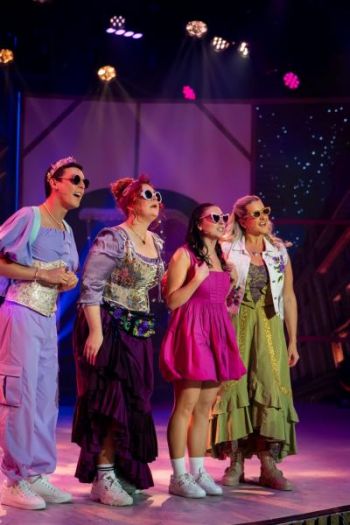
This was fundamental to all design concepts in the show. I wanted to subtly suggest that the Elizabethan world was dull and boring and a little bit limiting. However, once Juliet ‘finds her voice’ and travels to Paris, the world of the play would be colourful and more modern.
For costuming, I chose to remain true to the original style of the Broadway and London productions, however, I wanted to play with colours. I gave the costume team a detailed brief on colours for each character and then asked for the players to match the colours of the characters who were in control of the story. At the beginning the cast wore reds and browns to match Shakespeare and once they were in Paris they wore pinks, light blues etc. to reflect Juliet’s new world.
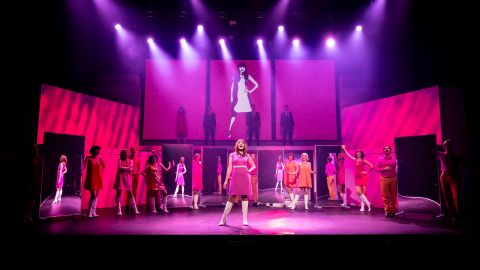
One of the first concrete ideas I had for the show was Romeo’s reveal in “It’s My Life”. We needed this moment to be high impact and have the same energy and drama that flying him in from the sky would have. Romeo’s entrance needed to disrupt the story; he needed to take over the stage. I decided we could achieve this by giving Romeo his own boy-band video which would be displayed all over the stage.
Romeo’s entrance meant my set needed screens, but I didn’t just want the screen to be up the back and I certainly didn’t want the screens to feature in the beginning of the play.
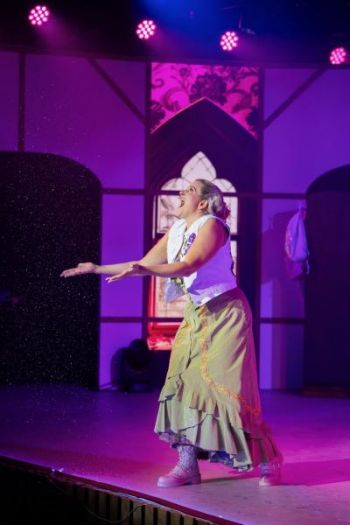 I wanted audiences to feel like they were stepping into an old Elizabethan Theatre and then have that space transform into a rock show once the story pivoted into Juliet’s story.
At this point I decided that the set would look like the outside of The Globe Theatre. I wanted the flats to wrap around the stage, so it looked like we had bisected The Globe. From there, I decided that the flats would be broken up with LED screens which would be covered in latticing.
Additionally, I wanted a level up the back and balconies at the front of the stage – a place for Romeo and Juliet to reunite at the end and a place for William and Anne to watch their play.
Looking back on it now I can’t believe all the things people said yes to, to make the set, screens and lighting rig a possibility.
The proscenium was disassembled, every incandescent light taken down, curtains, tabs and borders all came down, and a beautiful set and LED lighting rig went up. It was an epic task which took weeks to do.
Rehearsals & Tech Week
We had 26 rehearsals to get &Juliet ready for tech week. There are 17 dances and 29 songs in the show. It was a daunting prospect to learn but, thanks to my amazing cast and production team, we were able to pull off something special.
Every rehearsal was exciting to be a part of. I can’t believe how quickly the cast would pick up chorey (some admittedly faster than others), and how much better everything was when they came back. The dedication and passion in the rehearsal room was palpable.

I will never forget the first time we ran the show. We were a month out from tech and it was probably the strongest first run I have ever witnessed. Everyone lifted an extra level and at the end of the run, everyone was beaming.
Tech week came very quickly. A perk of the Miner’s Lamp is the company owns the theatre so the set was already in, so all focus could be on lighting, vision and sound.
We were so lucky to have the privilege to work with Em-Jay Media for audio and LKR Productions for lighting and screens.
We spent Friday, Saturday, Sunday and Monday plotting the show and programming screens. In the end the show had over 900 lighting cues.
Showtime
In the early stages of the rehearsal process, I was incredibly nervous as to how people would respond to our production not being like the professional version. But as rehearsals went on and we developed our version of the story, I became increasingly confident that audiences would fall in love with our show.
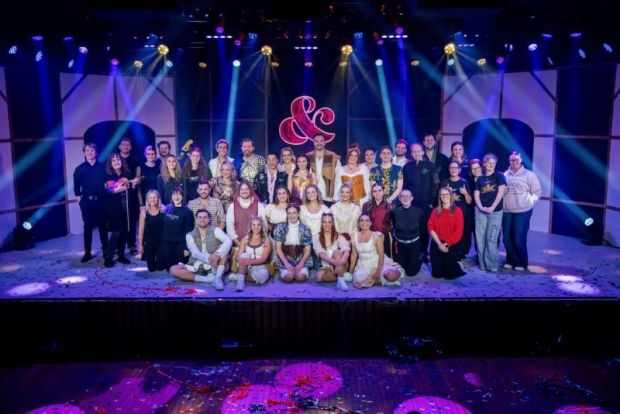
We were lucky to perform 13 sold out shows and at each and every show the cast’s energy was infectious. We may not have had all the fancy tricks of Broadway, but we had heart and each show created immense joy.
Photographer: Tracey Leigh